This is some text inside of a div block.
Search across the whole Roadsides site


Gilgit-Baltistan is home to more than 13,000 glaciers, which have profoundly shaped the region’s everyday life, moral values and ways of relating to the world. Long before the spread of organized religion, local communities formed ritual relationships with glaciers, understood not as passive reserves of water but as living, life-giving presences. Elders in the Hunza Valley, where I conducted ethnographic fieldwork, speak of glaciers as beings that breathe and possess souls, sustaining humans, animals, plants and unseen entities, so that daily survival is inseparable from practices of care and respect. Although many of the older rituals have changed over time, such connections have not disappeared; today, some young artists and musicians climb to glacier sites to offer music in acts of gratitude. These rituals symbolize an early form of ecological spirituality in which people recognized a higher, animating force responsible for the continuity of life (Ahmad-Khan 2022). As scholars like Allison (2015) and Millington (2024) have argued for other regions along the Himalayas, glaciers are imbued with spiritual and moral agency, emblematic of traditions that view these ice formations as life-sustaining forces and sacred companions. This perspective emphasizes relational ontologies that attest to glaciers’ capacity to interact with human actions and ethics (Cruikshank 2012).
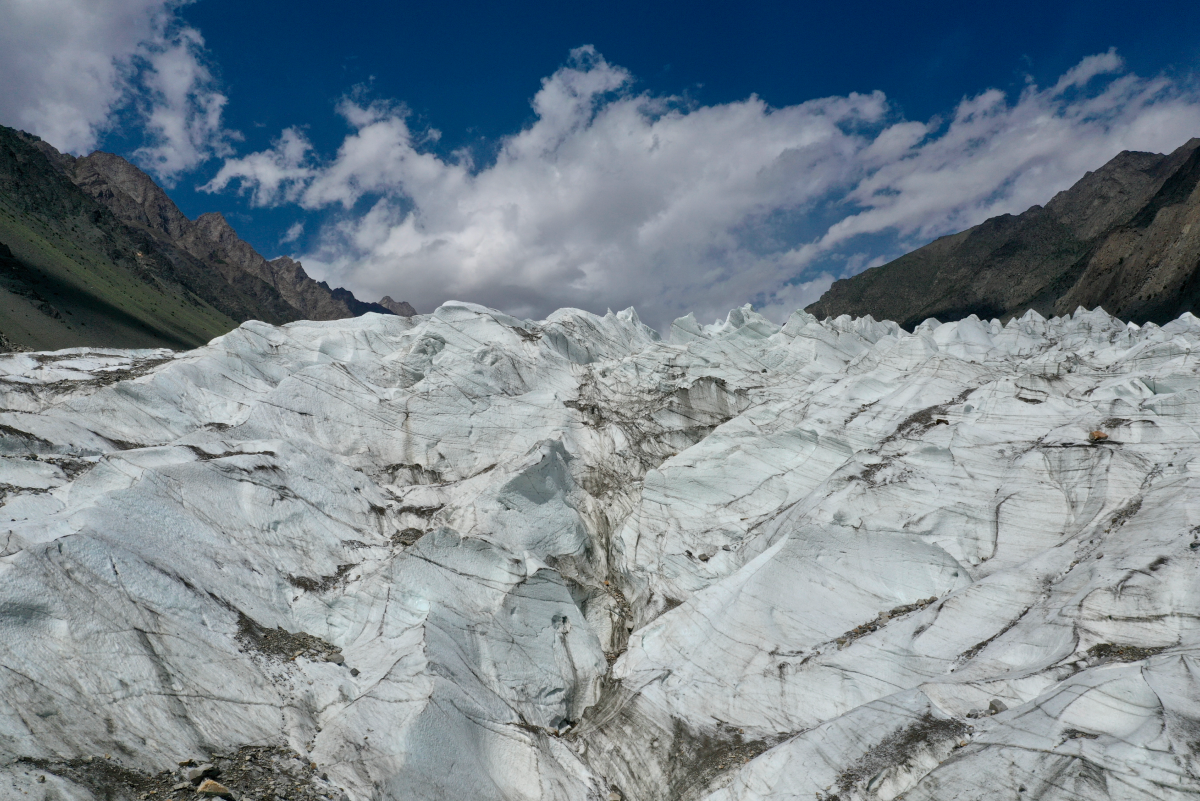
My observations of young musicians’ and artists’ practices in musical events at Passu Glacier and Borit Lake demonstrate how such performances produce knowledge about glaciers, climate and relational care that is inseparable from lived experience, improvisation and place-specific aesthetics. These insights offer a model for thinking about music, environment and spiritual ecologies.
Music occupies a sacred role in the cultural and spiritual fabric of Hunza (Schmid 2007). It is both an archive of ancestral memory and a living medium of ecological communication, through which respect for glaciers, moral responsibilities towards the land and warnings about environmental imbalance are expressed. Young residents have recently institutionalized this practice through annual high-altitude music festivals, where musicians and other artists ascend to glacier sites to perform mystic and shamanic compositions as acts of tribute.
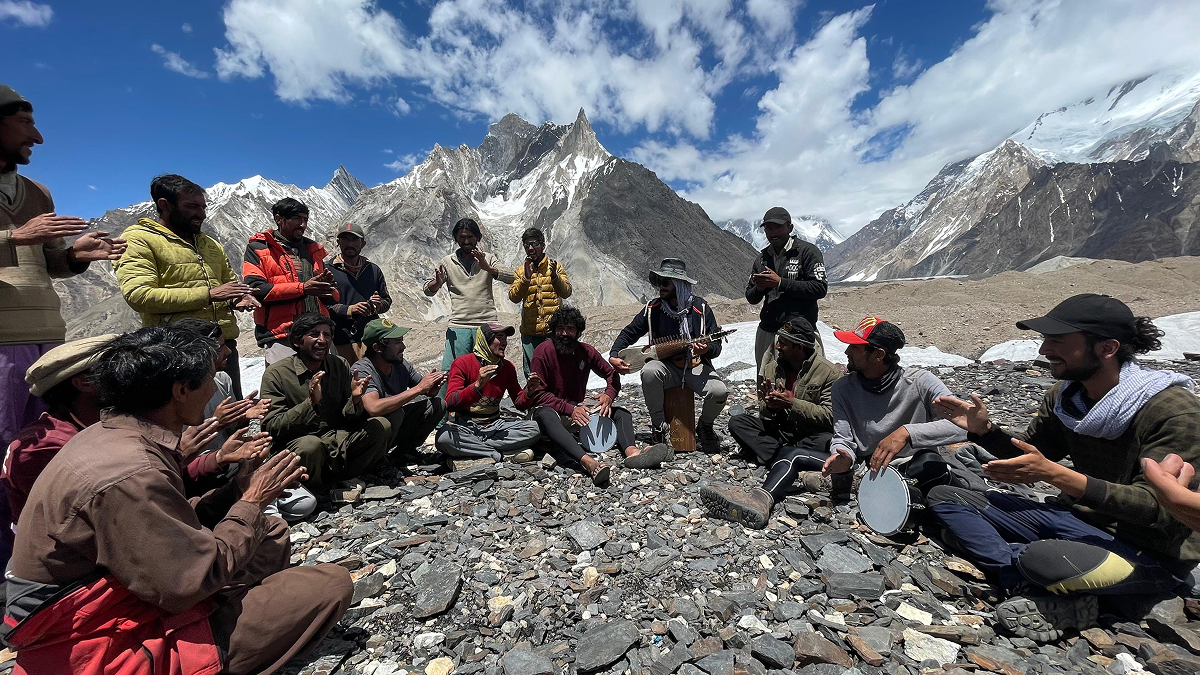
In June 2022, I began ethnographic fieldwork out of Islamabad, where I live, accompanied by Abdul, who supported field logistics, and Abrar, who documented the research process. Following a series of interviews with elders, we travelled to the Leif Larsen Music Center in Hunza to engage with young artists who organize the annual high-altitude music festivals. We journeyed with musicians Mujeeb and Jameel towards the Passu Glacier, stopping at Borit Lake along the way. At the lake’s edge, they pointed out a site where they had previously performed music facing the glacier, an encounter that crystallized a central insight: artistic practice here functions as an ethical relation, through which glaciers are addressed not as scenery but as participants in an atmospheric infrastructure. The material environment—the cold, crisp air, the reflective lake surface and the resonance of wind across ice—creates an aesthetic and sensory field that enables spiritual and ethical engagement.
This atmosphere is more than just a backdrop; it actively shapes musical performance, listening and improvisation, connecting humans to glaciers and other nonhuman beings across temporal and cosmological scales. For example, during the performances at Borit Lake and Passu Glacier, Mujeeb and Jameel adjusted tempo, volume and melodic structure in response to shifting winds and the acoustic reverberations of the glacial valley. Mujeeb described these adjustments not as technical choices alone but as acts of listening to the glacier and its surrounding landscape. Moments of silence were deliberately incorporated to allow glacial sounds, cracking ice, flowing meltwater and wind to enter the performance, producing a shared sonic space in which human and nonhuman agencies co-shaped the music.
After the performances at Borit Lake near Passu Glacier, Mujeeb and Jameel reflected on how their practice connects them to the surrounding environment. Here, they demonstrated their musical approach, highlighting the interplay between human performance and the natural soundscape. Mujeeb explained that at times he perceives the lake itself as a musical participant, producing subtle, shifting patterns of sound that interact with his own playing. For both Jameel and Mujeeb, the lake and the glacier are not merely a backdrop but active interlocutors, co-creators that shape improvisation, listening and their ethical attunement to place.
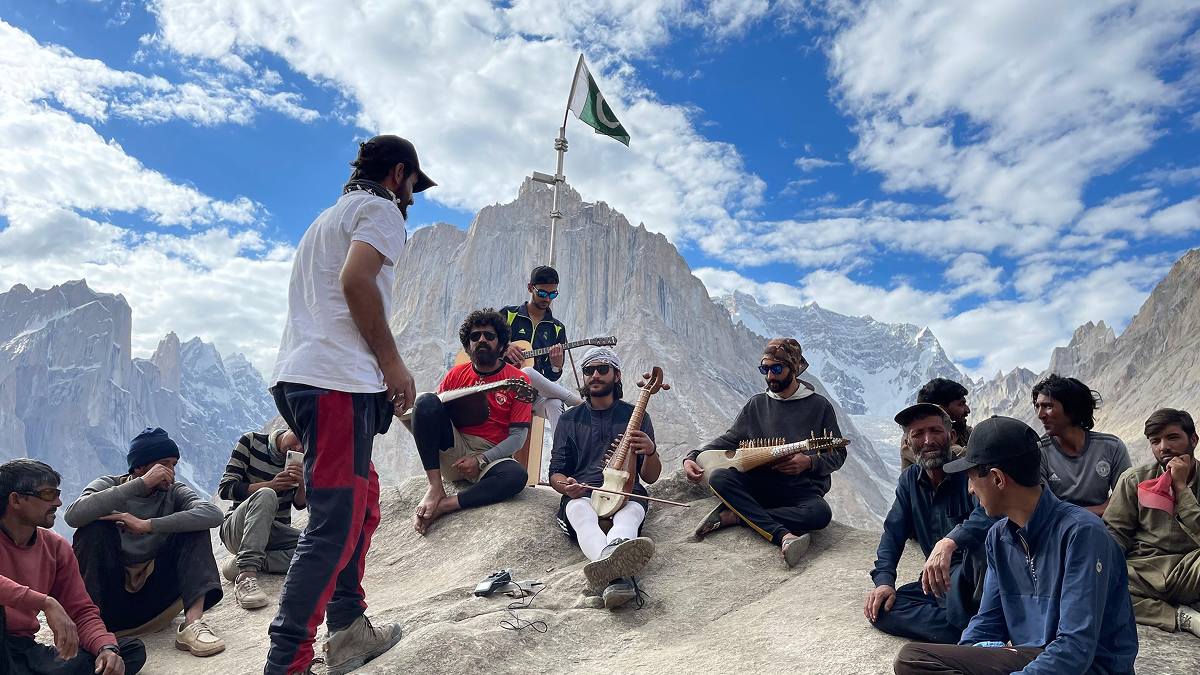
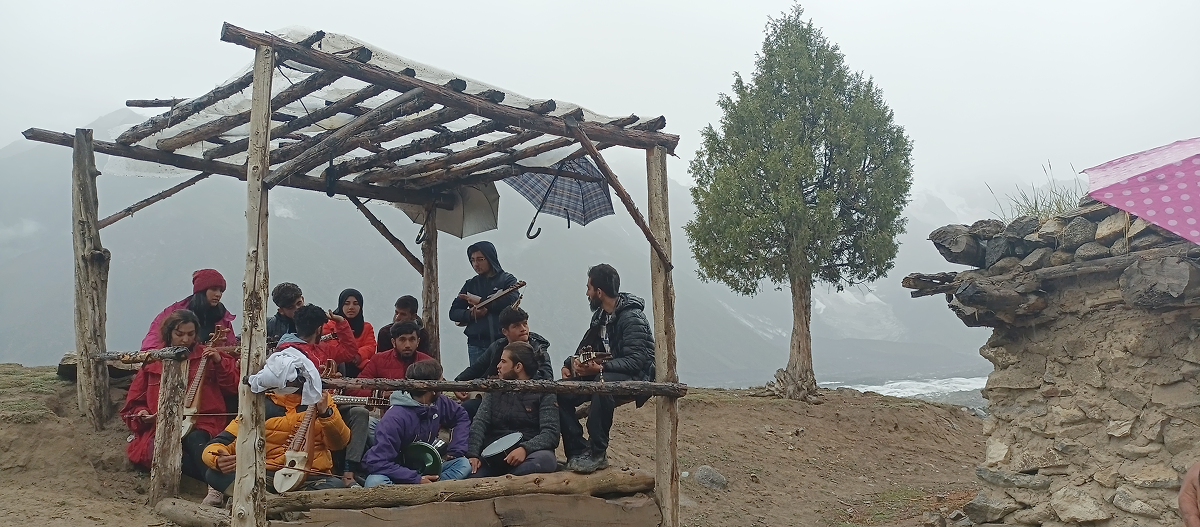
In a conversation that took place in summer 2022, Jameel, the young flautist from Hunza, narrates his journey as one of personal awakening intertwined with the glaciers:
When I was in 7th grade [13 years old], I developed an interest in playing the flute. My parents did not approve, so I would secretly visit glaciers and lakes to practice. What began as an act of rebellion transformed into a spiritual experience. I realized the glaciers were not silent; they reflected and responded to my music. Over time, I learned to tune my flute to the sound of melting ice and flowing water. The glaciers became my companions, they comforted me when no one else did.
Jameel’s story encapsulates a profound eco-spiritual dialogue, where the glacier is both muse and mentor, a being that reciprocates emotion and art. In this context, it emerges as a participant in social and cultural life, capable of relationality, affect and response. The musicians’ testimonies further illustrate the affective dimension of climate change, wherein environmental degradation is experienced not only as a physical crisis but as a spiritual and emotional rupture, both already felt and increasingly anticipated.
Over recent decades, sacred relationships with glaciers and high-altitude landscapes in Gilgit-Baltistan have been increasingly disrupted by processes of modernization, formal education, urban migration and development narratives that prioritize economic growth over local ecological knowledge. At the same time, people’s awareness of the value of heritage is expanding (Walter 2022).
The high-altitude music festivals can therefore be understood as deliberate acts of cultural resilience and ecological resistance, reaffirming sacred relations that modernization and development have eroded. Through melodies, lyrics and performance practices, young musicians reclaim glaciers as kin, mentors and co-creators of art and life. Musical engagement becomes both a medium of intergenerational knowledge transmission and a form of ethical attunement to nonhuman beings, reflecting inherited cosmologies while addressing contemporary ecological anxieties.
Zia, a violinist, describes his musical practice as an act of ecological devotion:
When people speak of glaciers without respect, I feel deep pain. They are beings with souls, constantly endangered by human negligence, yet they continue to protect and nurture us. During the high-altitude festival, I play shamanic tunes as an offering, and I can feel their acknowledgment, as if they listen.
Such expressions reflect a contemporary form of eco-animism (Haukeland and Fredriksen 2023), where artistic performance becomes a sacred exchange between humans and the nonhuman world.
While the younger generation’s musical practices continue inherited cosmologies of glacier reverence, they also innovate by incorporating new instruments, improvisational techniques and performance contexts that were not part of earlier ritual repertoires. These adaptations allow artists to translate traditional ethical and spiritual relationships into contemporary idioms, integrating personal expression, collective performance and environmental consciousness. In doing so, their music functions as both a continuation of ancestral ecological knowledge and a creative reimagining that responds to modern challenges, climate anxieties and changing social landscapes.
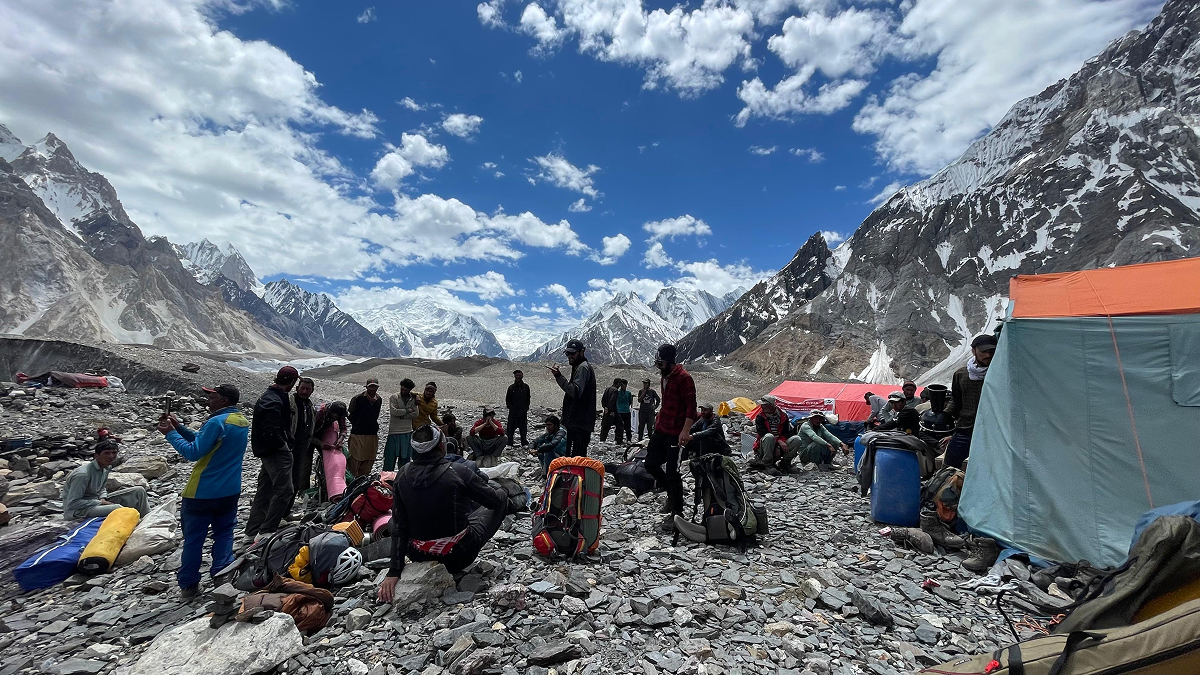
At Borit Lake, Mujeeb’s rubab began with a slow, pentatonic phrase, each plucked note lingering in the sharp high-altitude air, while Jameel’s flute wove ascending, airy motifs that floated across the water. The interplay of sustained drone and ornamented melody seemed to trace the undulations of the surrounding glacier, with pauses and crescendos mirroring the subtle shifts in wind and water. In one improvised passage, Mujeeb repeated a line under his breath—“the glacier listens as we remember”—which imbued the tune with a conscious acknowledgment of the glacier as sentient presence. The resonance between the instruments, the lake and the ice created a layered auditory environment in which human and cryospheric agencies co-acted: the glacier’s echoes and reverberations became part of the musical texture, while the musicians adapted phrasing, tempo and volume in response to these natural acoustic cues. Mujeeb emphasized this sense of collective indebtedness:
We, the people of Hunza, owe our existence to glaciers. They have sustained our ancestors for centuries. Our festivals are expressions of gratitude for their timeless service.
Through this practice, music functions as a form of cryospheric infrastructure: a medium that sustains intergenerational ecological knowledge, ethical relations and spiritual engagement with glaciers. The performance enacts continuity with ancestral cosmologies while innovating contemporary expressions of care, attentiveness and reciprocity. In this living dialogue, sound becomes prayer, the glacier both audience and collaborator, and the landscape itself participates in shaping and co-creating cultural and environmental understanding. These artistic engagements show how interspecies dialogues reimagine glaciers as ethical co-participants in the ongoing struggle against climate change.
1. How do the practices presented in the article differ from dominant conservation approaches or climate-adaptation frameworks?
2. What does this article suggest about the limits of global climate narratives when they overlook local spiritual and sensory relationships with the environment?
3. How might these relationships reshape how we think about climate action and responsibility?
Objective: To help students explore how sound can foster relationships with landscapes and nonhuman beings.
Activity steps:
Connect the exercise to the article by asking how sound can be understood as a form of communication, care, or ethical engagement with the environment.
Ahmad-Khan, Anfaal. 2022. “Geography, accountability and capital: an ethnography of ecological accountabilities in Gilgit-Baltistan.” PhD dissertation. University of Glasgow.
Allison, Elizabeth A. 2015. “The Spiritual Significance of Glaciers in an Age of Climate Change.” Wiley Interdisciplinary Reviews: Climate Change 6 (5): 493–508.
Cruikshank, Julie. 2012. “Are Glaciers ‘Good to Think with’? Recognising Indigenous Environmental Knowledge.” Anthropological Forum 22 (3): 239–50.
Haukeland, Per Ingvar and Biljana C. Fredriksen. 2023. "Crafting in a more-than-human world." In Crafting relationships with nature through creative practices, edited by Biljana C. Fredriksen and Per Ingvar Haukeland, 9-29. Scandinavian University Press.
Millington, Alice, 2024. “Himalayan Buddhism as Human Geological Agency: Rethinking the Novelty of ‘the Anthropocene’.” Journal of Global Buddhism 25 (1): 75–6.
Schmid, Anna. 2007. "The Dom of Hunza (Northern Areas of Pakistan)." In Disappearing Peoples: Indigenous Groups and Ethnic Minorities in South and Central Asia, edited by Barbara Brower and Barbara Rose Johnston, 107–27. Routledge.
Walter, Anna-Maria. 2022. “Images of the mountains: Touristic consumption and gendered representations of landscape and heritage in Gilgit-Baltistan.” Visual Anthropology 35 (3): 225–47.
The fieldwork for this research was generously supported by the Mehjabeen Fellowship.