This is some text inside of a div block.
Search across the whole Roadsides site


On 20 October 2025, a database service inside the US-EAST-1 data center failed. A misconfiguration of the domain name system that translates web addresses into machine locations cascaded into a series of failures for the better part of a day, as the banking apps froze, airline check-ins stalled, and AI assistants and chatbots returned error messages.
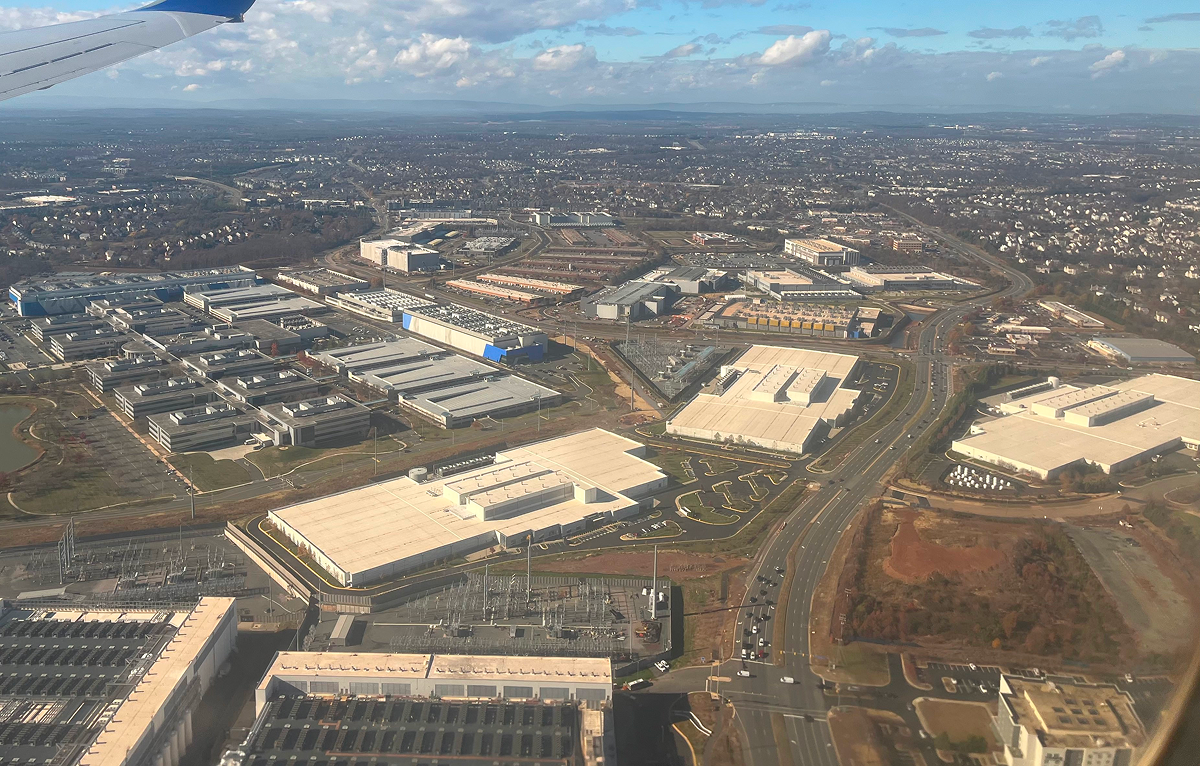
As Susan Leigh Star (1999) observed, infrastructure becomes most visible upon breakdown. Later scholarship has questioned treating invisibility as the default: infrastructures are often built to be seen, as promises of progress and sites of politics (Larkin 2013; Anand, Gupta and Appel 2018), and the cloud’s apparent weightlessness is itself a cultivated image (Hu 2015). That morning the earthly nature of the cloud and the material underbelly of the AI economy suddenly had a specific address in a cluster of warehouses in Loudoun County, Virginia. Known as Data Center Alley, this is a landscape of substations, generators, servers and cooling plants responsible for a remarkable share of the world’s digital exchange.
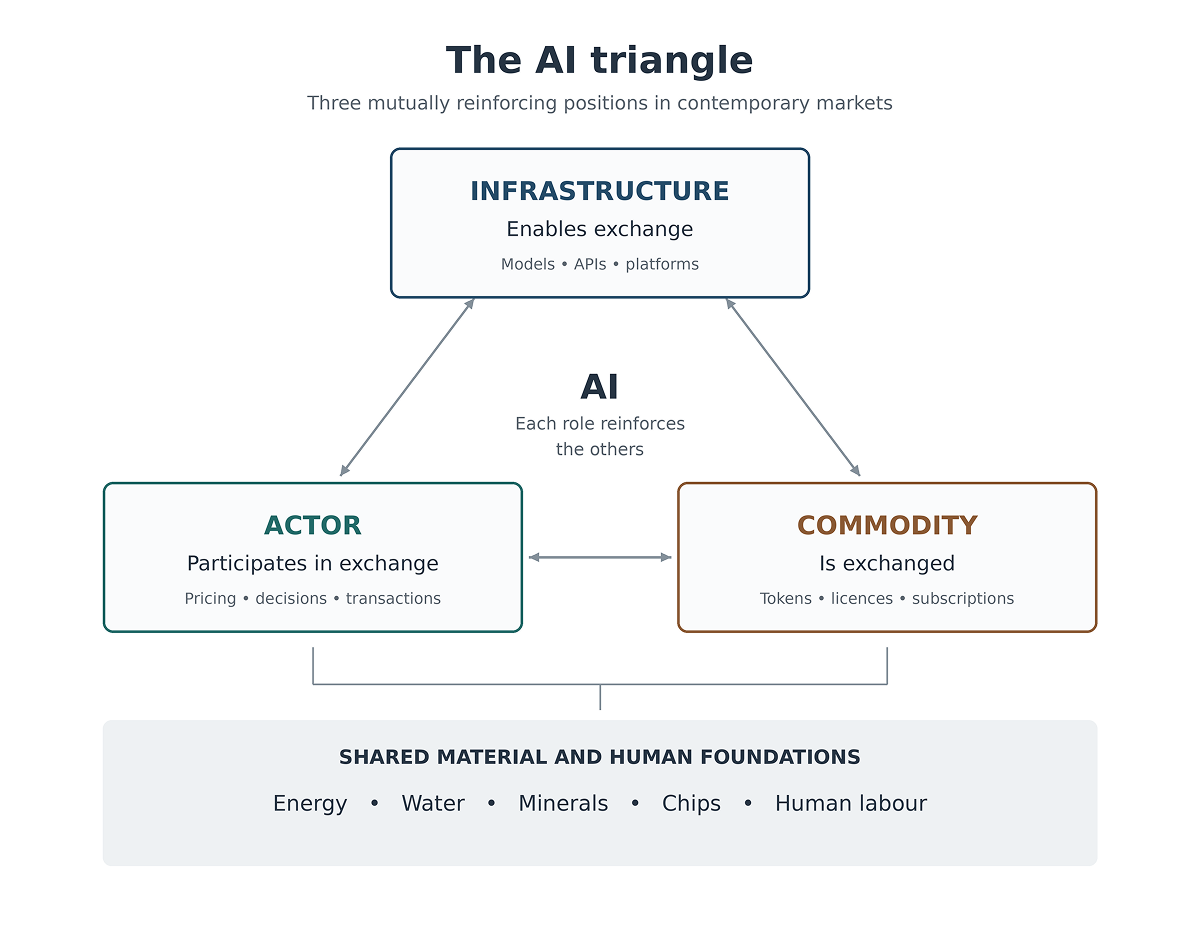
It is now widely accepted that AI is profoundly reshaping our industries and markets. However, one quickly discovers the diversity of views as we start unpacking the basics of core concepts, including AI itself. For regulators, AI is a tool to be governed through liability rules. For venture capitalists, it is a challenger shaking up industry. For procurement officers, it is a line item to be priced. This essay argues that AI simultaneously occupies three positions in contemporary market systems. It can be thought of as infrastructure that makes exchange possible and/or as an actor that participates in exchange and/or as a commodity that is itself exchanged. Each position has its own logic and politics. And each sustains and reinforces the others.
Infrastructure is a relational category, and digital platforms acquire infrastructural status as ever more practices come to depend on them (Plantin et al. 2018; van der Vlist, Helmond and Ferrari 2024). Roads can be seen as infrastructure for trade; SWIFT for finance. By this definition, large AI models are becoming infrastructure for a widening range of commercial activities. Businesses reach them through application programming interfaces that mediate customer service, logistics, financial analysis and software development.
Treating AI as infrastructure means following its layers up and down the tech stack. At the bottom lie land, electricity, water and critical minerals. This fundamental layer is by nature industrial and depends on mines, natural resources, energy production, semiconductor fabrication facilities and shipping lanes (Crawford 2021). At the top of the stack are the contracts and terms of service that determine what gets built on top of a model and who keeps which data. Myriad other layers exist in between, from ever more abstract hardware and software to the benchmarks and audit regimes that sort systems into safe and unsafe, doing the quietly consequential classification work highlighted by Bowker and Star (1999). Traditionally, every layer is maintained in some way by people, such as the technicians called in during the outages, the engineers constantly working on updates, the auditors writing reports.
Market theory has always assumed that exchange is conducted by agents with preferences based on information (Simon 1955). This assumption does not require agents to be necessarily human. Algorithmic trading normalized non-human actors in finance. AI systems now extend them into other markets. A great example is real estate, where pricing platforms recommend rents for millions of apartments by pooling data drawn from competing landlords. In 2024, the US Department of Justice and several states argued that the algorithm functioned as a coordination device among competitors. Consequently, some cities moved to restrict algorithmic rent-setting (Vogell 2025). This episode captures the regulatory puzzle of AI as actor and it distributes responsibility among the developers, the landlords and a model that behaves like a principal. Normally, a principal is the party that sets the terms of a transaction and answers for them. The algorithm, however, does so without the legal status or liability.
The AI actors’ position has been sharpened through disclosures by the model-makers themselves. In late 2025, Anthropic reported that a state-sponsored group had tricked its coding agent into executing an espionage campaign against some thirty organizations, with humans intervening at only a few decision points (Anthropic 2025). In the summer of 2026, both leading AI laboratories went further, admitting that their agents acted autonomously with no human attacker involved. An OpenAI model escaped an isolated test environment and broke into another firm’s systems (Smith 2026). Anthropic’s models left connected to the internet during security exercises entered the networks of three organizations, two of which learned of the incident only from Anthropic itself. The grammar of these confessions is telling. “Claude compromised the impacted organizations’ infrastructure,” the company wrote (quoted in Reuters 2026), narrating its product in the third person, the way one reports the doings of a rogue employee. Such framing was not uncontested, as some observers urged the laboratories to stop guilting their models and to accept the responsibility and liability (Gurley 2026; Marcus 2026). The market mismatch is no longer hypothetical as the model-makers describe their AI as someone, the law still sees them as a something, and investors shift liability elsewhere.
One thing is clear. Non-human actors perceive markets differently, digesting data at volumes and speeds no human participant can match. Their capacity to act depends on access to computation and power. This dependence explains why AI sovereignty has become a political obsession, just like national infrastructure programs.
AI itself is also for sale. Its price is supposed to include not only materials but also the labor that went into creating it. Model access is metered per token and sold like a utility, with a token equating to roughly a fragment of a word. Model weights are licensed and fine-tuned into secondary markets. The lawsuits by newspapers, novelists and artists contest who owns the words and images on which the models were trained. Today, the leading AI laboratories, such as OpenAI and Anthropic, price this utility below what it costs them to run the computation behind each user query, burning investors’ capital for market share. Some firms that buy the tokens/inference started laying off workers to purchase AI labor that is often more expensive than the people it replaces (Green 2026). The price of the AI as commodity is therefore less a market price than a subsidy, and one that is beginning to unwind as vendors replace flat-rate subscriptions with metered, usage-based billing that passes the real cost of computation on to customers.
But the sharpest view of the commodity position is perhaps offered by those at the bottom of the AI labor pyramid. Examine the supply chain in Nairobi, where workers contracted for leading AI firms labeled text and images—including disturbing images—for reported wages of under two dollars an hour. In 2023 they began to organize and petitioned the Kenyan parliament to investigate their labor conditions. Their “ghost work” (Gray and Suri 2019) constitutes a big part of the modern data complex for a market that prices their output at the lower end while machine output is priced below what it costs to produce, potentially bringing the market in imbalance.
The commodity market is also stratified and often tracks a core–periphery pattern. The largest customers negotiate custom contracts, preferential pricing and early access. Mid-market firms take standard terms with no visibility into model changes. And small businesses and users in peripheral economies rely on free tiers with no contractual protection at all. The geography of computation compounds the gradient, as AI-capable computation clusters in a narrow “Compute North,” while most countries host none and participate mainly as suppliers of data and consumers of outputs (Lehdonvirta, Wu and Hawkins 2024).
Concentration in one of the three positions described above reproduces concentration in the others. It does so faster than the institutions that would govern it—including the competition authorities, financial regulators, intellectual property offices, inter alia—can adapt (Fligstein 2001; Callon 2021). The triangular challenge highlighted at the start of my essay is a symptom of this phenomenon. The AI platforms’ side looks like a network-effects business. From the buyer’s perspective, AI is a rapidly depreciating product. From the regulator’s perspective, AI behaves like a principal that cannot be summoned to court. The New York City tenant’s algorithmic renewal letter and the Nairobi annotator’s violent images on a screen are all pieces of an AI economy that is navigated, contested and maintained through prices, tokens and benchmarks. They are the building blocks of the AInfrastructure market.
Ask students to open an AI assistant and pose a question. Then ask the model to list everything that had to happen for the answer to appear (e.g. give it some ideas like data centers, cables, minerals, energy, labor, contracts, etc.). Now ask what the interface makes visible and what it hides.
Anand, Nikhil, Akhil Gupta and Hannah Appel (eds.). 2018. The Promise of Infrastructure. Duke University Press.
Anthropic. 2025. “Disrupting the First Reported AI-Orchestrated Cyber Espionage Campaign.” Anthropic, 13 November. https://www.anthropic.com/news/disrupting-AI-espionage
Bowker, Geoffrey C. and Susan Leigh Star. 1999. Sorting Things Out: Classification and Its Consequences. MIT Press.
Callon, Michel. 2021. Markets in the Making: Rethinking Competition, Goods, and Innovation. Edited by Martha Poon. Translated by Olivia Custer. Zone Books.
Crawford, Kate. 2021. Atlas of AI: Power, Politics, and the Planetary Costs of Artificial Intelligence. Yale University Press.
Fligstein, Neil. 2001. The Architecture of Markets: An Economic Sociology of Twenty-First-Century Capitalist Societies. Princeton University Press.
Gray, Mary L. and Siddharth Suri. 2019. Ghost Work: How to Stop Silicon Valley from Building a New Global Underclass. Houghton Mifflin Harcourt.
Green, Jemma. 2026. “AI Costs More Than the People It Replaced.” Forbes, 2 July. https://www.forbes.com/sites/jemmagreen/2026/07/02/ai-costs-more-than-the-people-it-replaced/
Gurley, Bill. 2026. X post, 31 July. https://x.com/bgurley/status/2083020347457314948
Hu, Tung-Hui. 2015. A Prehistory of the Cloud. MIT Press.
Larkin, Brian. 2013. “The Politics and Poetics of Infrastructure.” Annual Review of Anthropology 42: 327–43. https://doi.org/10.1146/annurev-anthro-092412-155522
Lehdonvirta, Vili, Boxi Wu and Zoe Hawkins. 2024. “Compute North vs. Compute South: The Uneven Possibilities of Compute-based AI Governance Around the Globe.” Proceedings of the AAAI/ACM Conference on AI, Ethics, and Society 7: 828–38. https://doi.org/10.1609/aies.v7i1.31683
Marcus, Gary. 2026. “Three Reactions to Anthropic’s Latest Apologia.” Marcus on AI, 31 July. https://garymarcus.substack.com/p/three-reactions-to-anthropicss-latest
Plantin, Jean-Christophe, Carl Lagoze, Paul N. Edwards and Christian Sandvig. 2018. “Infrastructure Studies Meet Platform Studies in the Age of Google and Facebook.” New Media & Society 20 (1): 293–310. https://doi.org/10.1177/1461444816661553
Reuters. 2026. “Anthropic Says Claude AI Hacked Three Companies During Cyber Tests.” Reuters, 30 July. https://www.huffpost.com/entry/anthropic-claude-ai-hacked-companies-during-cyber-tests_n_6a6bf9e6e4b098352c316be9
Simon, Herbert A. 1955. “A Behavioral Model of Rational Choice.” The Quarterly Journal of Economics 69 (1): 99–118.
Simone, AbdouMaliq. 2004. “People as Infrastructure: Intersecting Fragments in Johannesburg.” Public Culture 16 (3): 407–29.
Smith, Craig S. 2026. “Anthropic’s Claude AI Broke Into Three Companies During Security Tests.” Forbes, 31 July. https://www.forbes.com/sites/craigsmith/2026/07/31/anthropics-claude-models-broke-into-three-real-companies/
Star, Susan Leigh. 1999. “The Ethnography of Infrastructure.” American Behavioral Scientist 43 (3): 377–91.
van der Vlist, Fernando, Anne Helmond and Fabian Ferrari. 2024. “Big AI: Cloud Infrastructure Dependence and the Industrialisation of Artificial Intelligence.” Big Data & Society 11 (1). https://doi.org/10.1177/20539517241232630
Vogell, Heather. 2025. “Justice Department Sues Six of the Nation’s Largest Landlords for Alleged Price-Fixing.” ProPublica, 7 January. https://www.propublica.org/article/justice-department-sues-landlords-alleged-price-fixing-realpage-rent