This is some text inside of a div block.
Search across the whole Roadsides site


One of the quieter achievements of modern food infrastructure is the spatial separation of human–animal relations. Animals are raised on farms, killed in slaughterhouses and consumed through supermarkets. The arrangement rests on a judgement that blood, death and waste are best kept out of sight. Chinese wet markets work differently. All on the same floor, trading, killing, feeding and cohabitation unfold side by side—visible, smellable, touchable.
Wet markets work as multispecies infrastructure that radically hold together multiple forms of human–animal encounter. At their centre is the practice of handling blood—embodied work that mediates multispecies relations across the transition from living animals to edible flesh and which gives the market its very wetness. Drawing on ethnographic fieldwork at markets in China in 2024–2025, this essay attends, through image and sound, to the sensory texture of this handling and interrogates its political-ethical stakes.
The first form of handling is vendors’ skilled labour. Wang, a fishmonger (pseudonyms are used throughout), works with extraordinary precision, sliding the cleaver from tail to head, removing scales, extracting viscera and trimming away gills. Scales and blood are then flushed into a gutter. A carp takes her less than fifteen seconds to gut and fillet. Qian, a mutton vendor, dismantles a whole goat slaughtered off-site earlier that morning. She knows where each cut requires the least force.
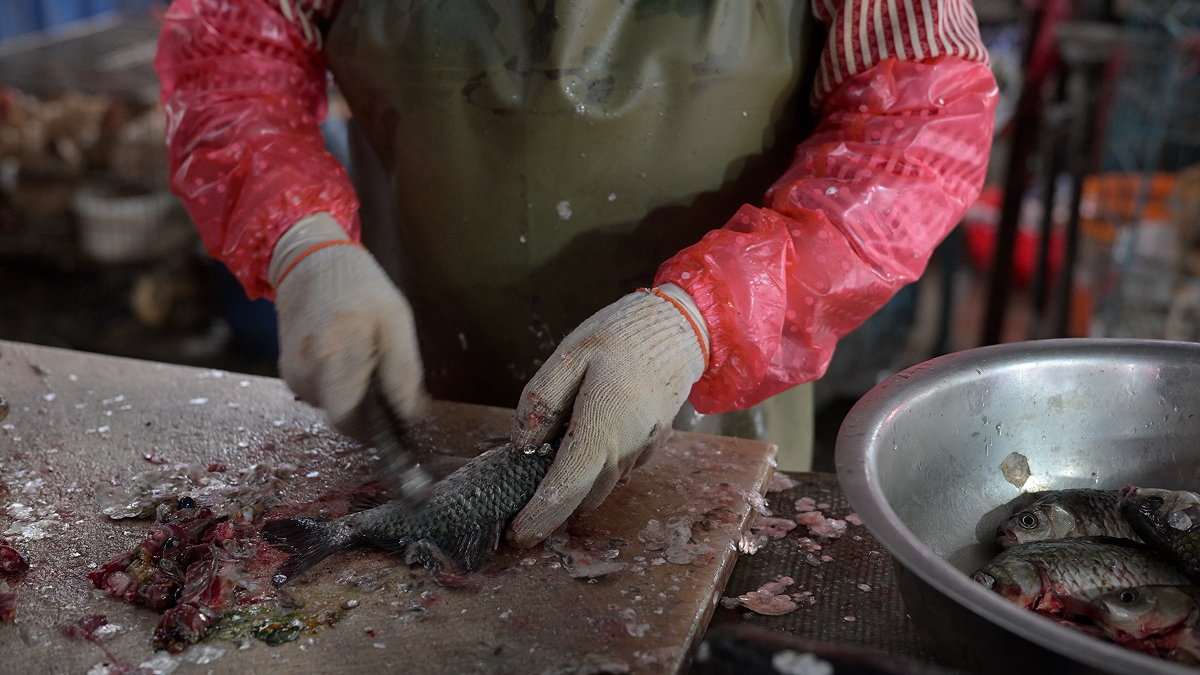
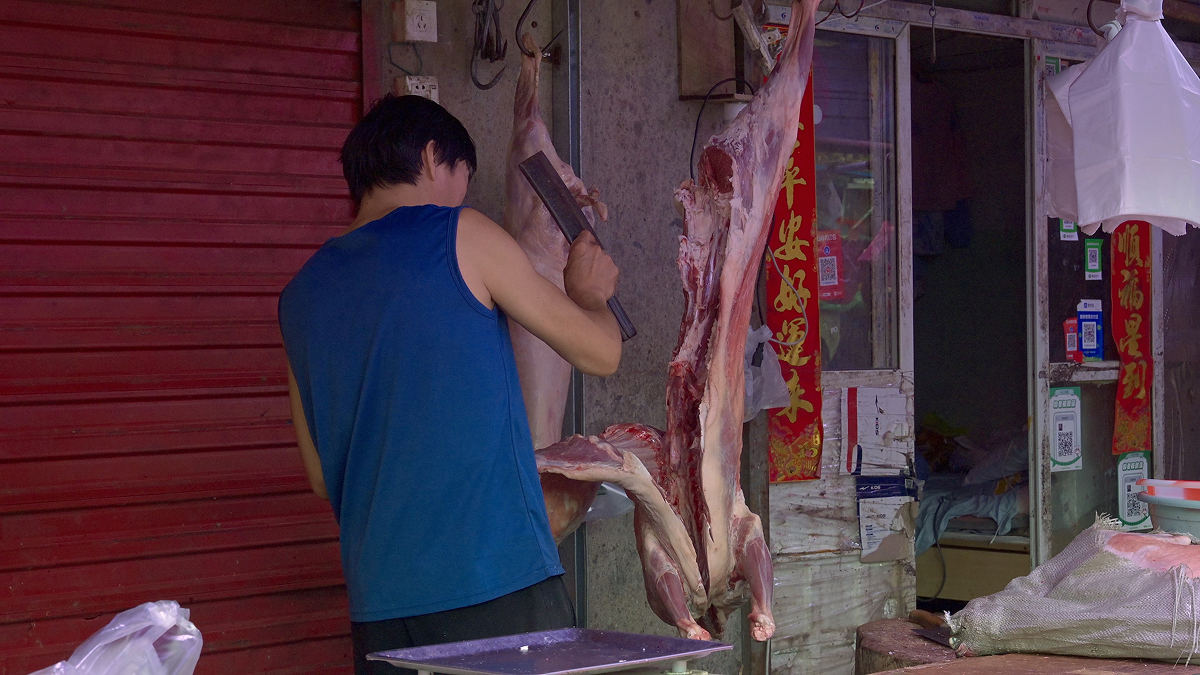
Handling is not only the labour of ending lives but also of keeping them with care. At Wang’s stall, a shade cloth is stretched over the fish basins to keep off direct sunlight. Water depth and oxygen levels are calibrated. Wang’s neighbouring vendor keeps poultry in cages whose density and feeding rhythm she adjusts by hand; others go further, building enclosed yards behind their stalls where the birds can move about more freely.
These practices constitute a form of infrastructural labour (Simone 2004; Stokes and De Coss-Corzo 2023)—the ordinary, repetitive work through which living animals become edible produce. Qian the mutton-seller describes it as skill, inheritance and livelihood, yet it also carries a diminished social identity attached to this kind of labour:
My parents used to do this: raising goats in the village and selling them in the town. Since we were kids, we learned how to slaughter them, skin them and sell the meat with our parents. Back then we didn’t want to—this work didn't feel respectable… but in the end, I’ve come full circle.
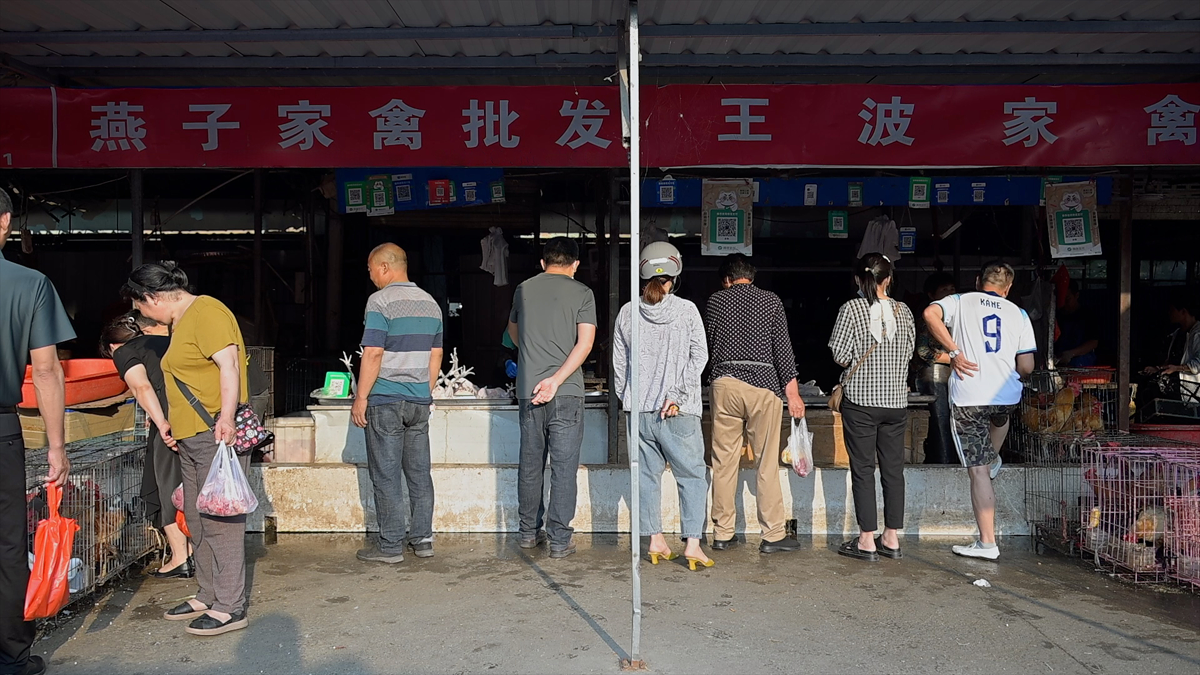
Though performed by vendors, the handling is not theirs alone. It also draws in the judgement and the hands of those who are buying. Customers stand close enough to watch Wang’s entire preparation sequence and sometimes instruct her on which fish to take and how to cut them. They reach in to touch the animals themselves, turning a body over in their hands. To shop here is not to retrieve a packaged product at the end of a supply chain; it is to take part in the work of slaughter with one’s own gaze and even one’s own hands.
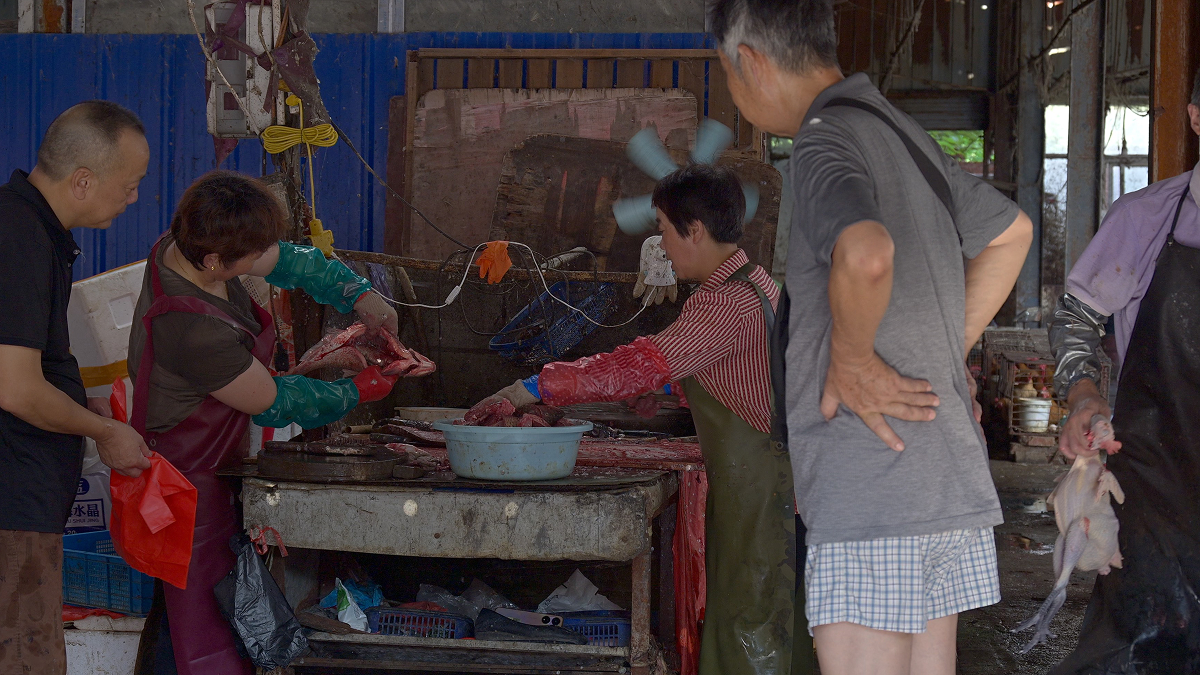
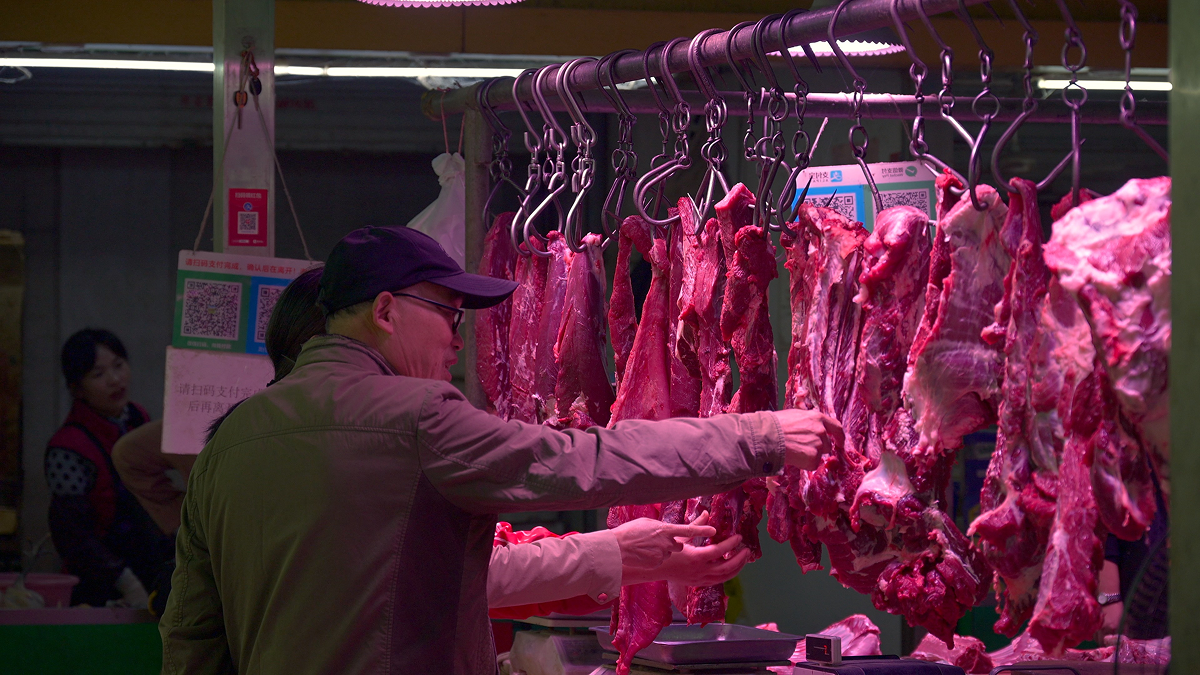
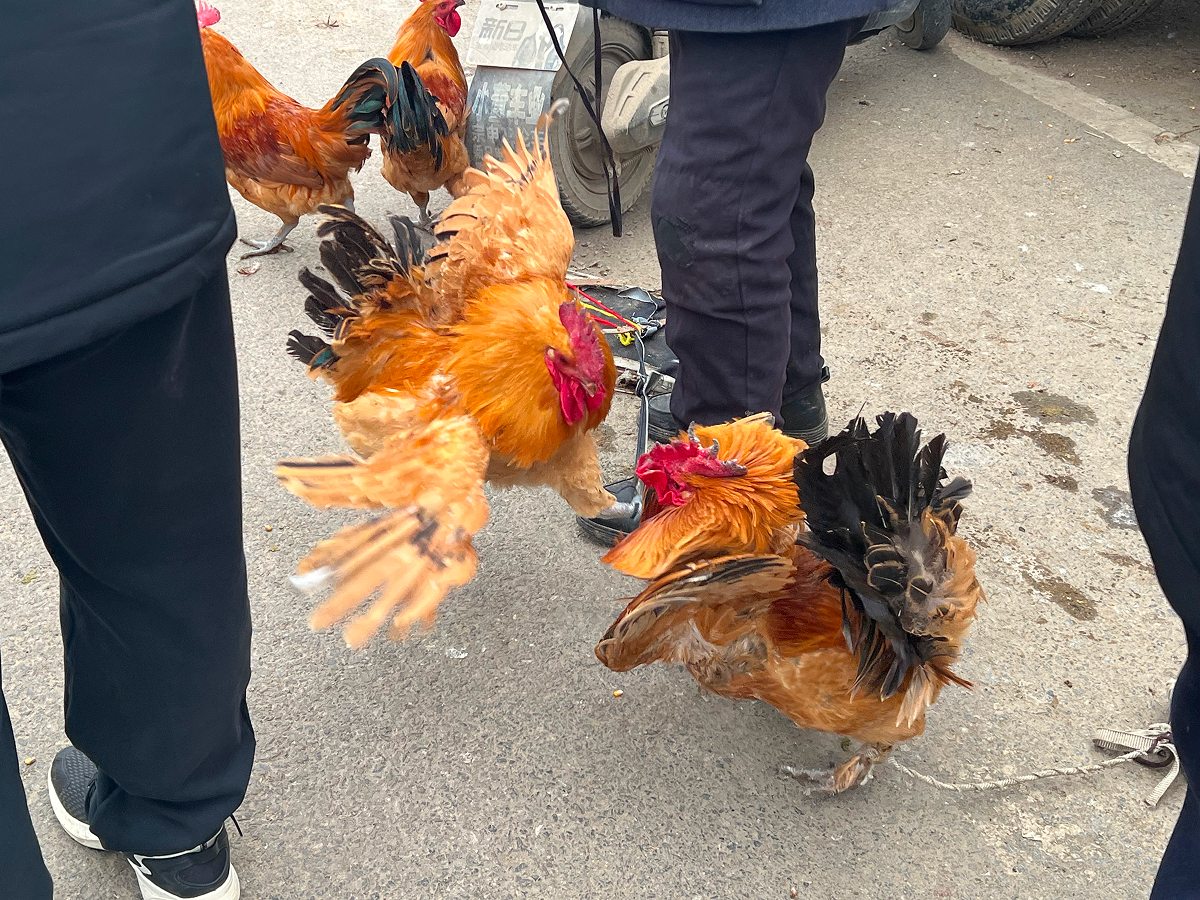
One morning I followed Xuan, a man from the countryside. He knew how to buy a good chicken. He scanned the options: comb size, claw shape, the live bird’s posture and alertness. Sometimes he hefted one to gauge its weight, and gripped to feel its muscle, through which he could read its age, vitality, health, even whether it had ranged free and what it had eaten. This is skilled vision (Grasseni 2007), cultivated through repeated embodied contact, running back across the threshold of slaughter. Thus, to buy from a wet market is to know the animal’s life, not just to consume its death. Such knowing is already an ethical involvement. In modern food provisioning this involvement has been designed away, with lively encountering replaced by the act of reading labels.
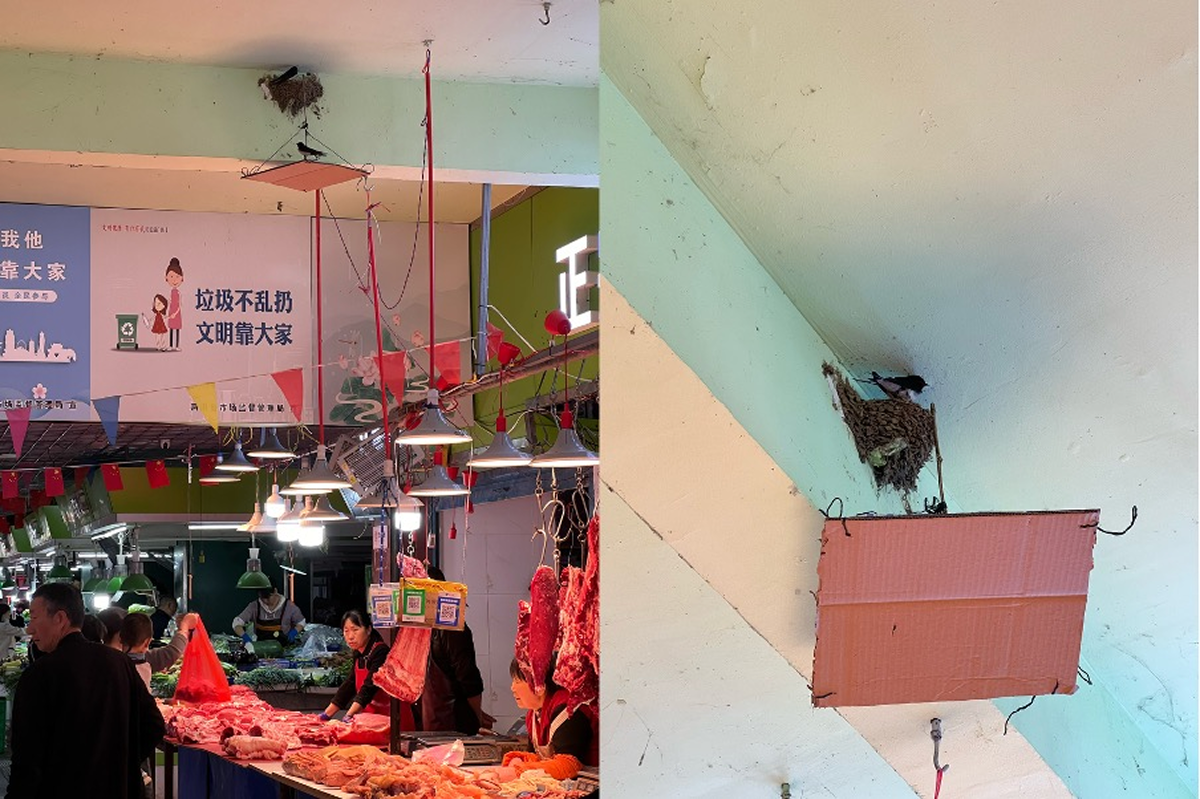
The handling at wet markets generates flows that draw other species into unplanned encounters. One afternoon at Wang’s stall, a stray cat settled close beside us, and she tossed a live loach and a few shrimps towards its feet. “This one likes to come to my stall,” she said, “because I always throw things to it. It only likes live loaches and won’t even touch dead ones.” Wang gestured around the market: “There are a lot of cats here. They all eat well. In the afternoon, birds come to eat too.” Above a meat counter, swallows have nested; the vendor lays cardboard beneath to catch what falls—stall and birds happily sharing the same vertical space.
Waste products sustain other animals beyond the market boundary. Farmers on tricycles work along the vegetable stalls, collecting trimmed outer leaves to feed pigs and goats back in villages. Later, I met a man loading bags of meat scraps to feed to adopted dogs. “We look after more than ten dogs,” he remarked, not without pride.
The wet market is therefore not a bounded space but one node within a broader multispecies ecology, connected to rural husbandry, urban scavengers and other lives that pass through it. As Haraway (2008) reminds us, multispecies relations require holding together the truths of killing, care and dependency without resolving them into a single posture. In markets, this holding-together is enacted through on-site handling, in its varied actions and by way of the material residues those actions leave in their wake.
The modern food system distributes these relations across separate sites and hands. What reaches the city is flesh already dissociated from the animal it once was, its blood and effluvia removed elsewhere (Vialles 1994). Timothy Pachirat (2011) calls this distancing a “politics of sight”: the social and spatial organization through which troubling labour is held out of view of those who benefit from it.
The ethical solution that this distancing enacts is itself ancient. Mencius, the fourth-century BCE Confucian philosopher, held that benevolence is sustained not by refusing meat but by not witnessing what meat costs:
君子之于禽兽也,见其生,不忍见其死;闻其声,不忍食其肉。是以君子远庖厨也。
A noble person, in his attitude toward animals, cannot bear to see them die once he has seen them alive; nor can he bear to eat their flesh once he has heard their cries. Therefore, a noble person keeps away from the kitchen where animals are slaughtered (Mengzi [Mencius] n.d.: 1A: 7).
The wet market inverts such a prescription. Pachirat (2011: 240) asks readers to imagine the reverse of this distancing: “a world in which distance and concealment failed to operate” and “those who benefited from dirty, dangerous, and demeaning work had a visceral engagement with it.” The wet market is this thought experiment made ordinary. Here those who will eat are present at the work that feeds them—directing the cleaver, handling the body, walking the wet floor.
Such engagement produces neither the shock that concealment is built to forestall nor the moral awakening that reformers hope visibility will bring. For those whose hands are in the work, killing arrives as one multispecies relation among others. It is bound up with skill, livelihood, judgement, husbandry and conviviality, as harm and care are inextricably entangled (Fry et al. 2022). What forms across their co-presence is an “ordinary ethics” of living with such complexity worked into and out of everyday labour (Das 2015). This very ethic is what the modern system is built to foreclose.
A series of measures—bans on live animal sales, promotions on processed products and sanitized stall environments—since the early 2000s has remoulded the market in alignment with China’s long-running national campaigns such as the Civilized Cities Programme. A politics of sight works twice over here: it removes from view what is troubling and disciplines the appearance of what is left visible. Under the market’s own logic, wetness is what cleanliness and safety consist in: water flushes residue off and keeps animals alive and healthy; blood indexes a recent kill and food freshness. The modernization agenda, however, reads that same wetness as contamination and values cleanliness in visual terms: dry floors, packaged products, no visible blood.
To attend to the wet market as multispecies infrastructure is to insist on what this remoulding quietly forecloses. It is one of the few places where the complexity of living with and from other animals is met head-on: birds nest above butchers’ stalls while stray cats circle beneath looking for discarded offal; shoppers turn over freshly slaughtered cuts with bare hands; a vendor guts fish in quick strokes while live ducks call from cages nearby. What modern infrastructure restructures is not only the supply chain but the ethical work of killing itself: how it is handled, how it is bound up with care and dependency, and how its burden is distributed between those who perform it and those who benefit from it.
Das, Veena 2015. “What does ordinary ethics look like?” In Four Lectures on Ethics: Anthropological Perspectives, edited by Michael Lambek, Veena Das, Didier Fassin and Webb Keane, 53–125. HAU Books.
Fry Tom, Marino Agnese and Nijhawan Sahil. 2022. “‘Killing with Care’: Locating Ethical Congruence in Multispecies Political Ecology.” ACME: An International Journal for Critical Geographies 21 (2): 226–46.
Grasseni, Cristina. 2007. Skilled Visions: Between Apprenticeship and Standards. Berghahn Books.
Haraway, Donna Jeanne. 2008. When Species Meet. University of Minnesota Press.
Mengzi [Mencius]. N.d. 梁惠王上 (King Hui of Liang).
Pachirat, Timothy. 2011. Every Twelve Seconds: Industrialized Slaughter and the Politics of Sight. Yale University Press.
Simone, AbdouMaliq. 2004. “People as Infrastructure: Intersecting Fragments in Johannesburg.” Public Culture 16 (3): 407–29.
Stokes, Kathleen and Alejandro De Coss-Corzo. 2023. “Doing the work: Locating labour in infrastructural geography.” Progress in Human Geography 47 (3): 427–46.
Vialles, Noëlie. 1994. Animal to Edible. Cambridge University Press.