This is some text inside of a div block.
Search across the whole Roadsides site


On Saturday evenings, Ms. Brown’s kitchen table becomes a financial infrastructure. Bills move quickly through her hands with the dry sound of worn paper. Twenty-dollar notes slide over each other before she gathers them into small bundles with elastic bands. A sharpened pencil rests between her fingers while she scratches names, amounts and missed weeks into a crowded notebook already marked by smudged calculations and crossed-out payments. The scratching of graphite mixes with the low bubbling of soup simmering in a large aluminum pot nearby. Odors of pimento, thyme, garlic and Scotch bonnet drift through the apartment. Not everyone arrives at the same time. Some women stop by briefly after work. Others stay longer, drinking tea at the kitchen table while discussing relatives in Jamaica, immigration paperwork, rising rent, church news or children back home. The money, however, is always counted carefully.
The women call it “partner,” often pronounced pardner; a Jamaican form of rotating savings and credit association (ROSCA). Each participant contributes a fixed amount, known as a hand; the pooled amount, the draw, is then given to one member according to a rotating order. ROSCAs have long attracted anthropological attention because they reveal how financial practices simultaneously operate as economic, social and moral institutions (Geertz 1962; Ardener and Burman 1996). Jamaican partner banking belongs to this broader family of financial practices, while developing its own diasporic histories and moral worlds (Handa and Kirton 1999). Participants receive the pooled amount in a previously agreed order, although urgent financial needs may lead to a renegotiation of turns. All members continue contributing, even after receiving their own payout, until everyone has received a draw.
My focus here is not on partner as a general financial form, but on how one particular partner in Montreal was held together through domestic space, gendered responsibility and the everyday labor of trust. Rather than asking how trust enables partner banking, this essay considers how trust itself is continuously produced through the gendered infrastructural labor that keeps partner moving. To call partner ‘informal’ is accurate only in a narrow regulatory sense: it is not primarily organized through state-backed contracts or formal banking institutions. It does not mean that the system is unstructured, external to financial capitalism or loosely organized. On the contrary, partner relies on dense forms of timing, repetition, accountability and social labor.
For many women in Montreal’s Jamaican diaspora, the draw is already socially committed before it arrives. One woman plans to send money to her mother in Jamaica whose medication costs have increased. Another needs school fees for a child back home. Others quietly calculate upcoming rent payments, immigration documents or overdue bills while waiting for their week in the cycle. The draw is already committed in advance through obligation and anticipation. Futures are attached to the money before it changes hands. Ms. Brown acts as the group’s banker. She collects contributions, keeps records, follows up on delayed payments and decides who receives the draw next. The position carries responsibility and risk. “You have to know how hard people work for their money,” she tells me one evening while re-counting the cash before placing it into envelopes. “You cyaan [cannot] mess with it,” she says with a serious tone of voice.
Responsibility here means more than financial administration. It means protecting livelihoods, relationships and reputations. Several participants either lack stable access to formal banking or distrust institutions that repeatedly render them economically precarious through migration uncertainty, temporary work or bureaucratic exclusion. Under such conditions, the partner becomes one of the few reliable ways to organize larger sums of money through relationships that feel socially accountable. The partner does not function through contracts or legal guarantees. It depends on social visibility. Women trust Ms. Brown because she embodies a particular form of diasporic moral personhood. She is older, church-connected, financially disciplined and deeply embedded within Montreal’s Jamaican community. People describe her as “proper,” “God-fearing” and “someone who helps people.” Trust emerges less from financial expertise than from the careful cultivation of reputation over time (Thomas 2004). Much of this reputation is produced within the same domestic space where partner meetings unfold. The kitchen table matters because it reveals coordination at the scale of everyday domestic life. It is where contributions are received, futures are sequenced, delays are absorbed and trust becomes durable enough for exchange to continue.
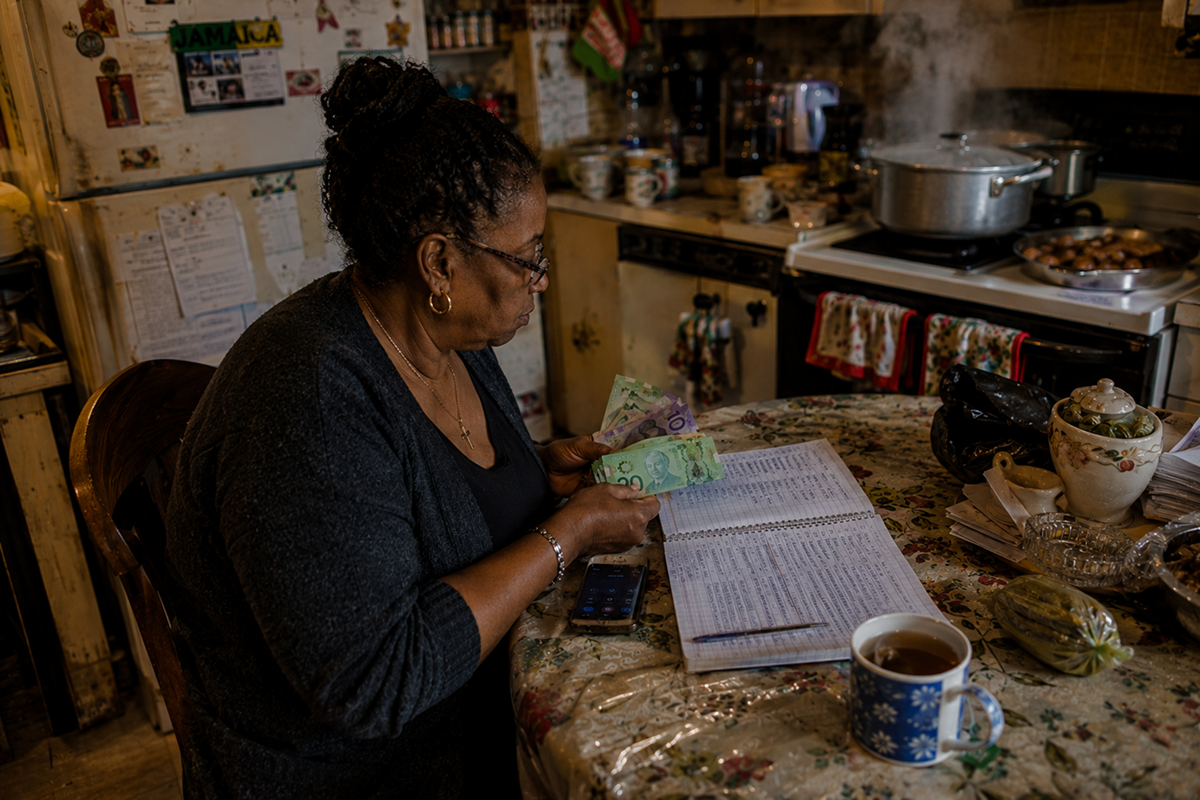
Ms. Brown’s kitchen is small but meticulously organized. Conversations around the dining table stretch across hours of cooking, storytelling, financial coordination and waiting. Money moves alongside migration memories, church obligations, recipes and discussions about relatives in Jamaica. The boundaries between domestic care and financial coordination remain deliberately porous. Cooking itself carries moral weight. Ms. Brown prepares food according to routines she associates with her grandmother in rural Jamaica: red pea soup simmering slowly in a big pot (Dutchie), coconut milk prepared for rice and peas, herbs and spices added in a precise order learned during childhood. “If the pepper buzz (bursts), the whole soup spoils,” she explains while stirring the pot carefully. Her grandmother, she recalls, “used to help everybody,” sharing food with neighbors, raising children for others and distributing handouts to poorer people in the community. “The only thing she feared was God.” These memories are not separate from the partner. The same moral framework that structures cooking, caregiving and community obligation also structures financial trust.
Women trust Ms. Brown with money because they trust her conduct, discipline, discretion and sense of responsibility. Trust is reproduced through church networks, domestic routines, kinship obligations and reputational visibility. In this sense, the kitchen table does not simply host the financial infrastructure; it is part of the infrastructure itself. As Simone (2004) suggests, infrastructures may emerge through social coordination rather than technical systems alone. The partner depends on continuous acts of maintenance: remembering who paid, quietly reminding someone their hand is due, negotiating delays without public embarrassment, balancing flexibility against the risk of destabilizing the draw. Much of this work happens before the money itself moves.
The infrastructure becomes most visible when payments are delayed. A missed hand threatens more than the weekly cycle. It risks tension within the wider community. Maintaining the partner therefore requires ongoing acts of repair, mediation and anticipation (Jackson 2014). Too much pressure can humiliate someone already struggling financially; too much flexibility can undermine trust in the entire system. Women like Ms. Brown absorb these tensions quietly through phone calls, reminders, adjustments and careful observation. Financial circulation depends upon intimate forms of social knowledge rarely recognized within conventional accounts of finance. Similar forms of Black cooperative financial labor have been described by Hossein (2018) as community-based economies sustained through care, accountability and social obligation. Partner banks are often described as alternatives to formal financial systems. Yet the women participating in Ms. Brown’s partner do not imagine themselves outside capitalism or outside financial modernity. Many women work long hours in caregiving, nursing and service sectors while simultaneously financially supporting relatives across borders. Rather than replacing formal banking, the partner fills practical and moral gaps created by migration uncertainty, insecure employment and uneven access to financial services. Its gendered character lies not simply in women's participation, but in their largely unrecognized labor of maintaining the trust, obligations and accountability on which this form of credit depends.
Partner allows women to manage obligations that exceed the possibilities of weekly wages and precarious employment. At Ms. Brown’s kitchen table, financial infrastructure is assembled through small, repetitive acts: counting bills, tying bundles, scratching names into paper, stirring soup, answering phone calls and waiting for the next draw. These practices rarely appear in conventional accounts of markets or finance. Yet they sustain the circulation of remittances, payments, care, obligation and anticipation across diasporic life. The notebook, the envelopes, the phone calls, the soup and the kitchen table are not background details. They are the material through which the partner endures. Thinking with such infrastructure shifts attention away from markets as abstract systems toward the ordinary work through which exchange is continually made possible. By the time the money changes hands, the relations of trust and obligation that make this form of financial exchange possible have already been assembled.
Ask students to trace everything required to keep the partner moving for one week. Starting from the kitchen table scene, identify all visible and invisible forms of labor involved in organizing the draw: counting money, recording payments, making phone calls, managing delays, maintaining reputation, preparing food, remembering obligations and anticipating future needs. Students may then discuss which of these activities are usually recognized as financial work and which forms of infrastructural labor tend to remain invisible.
Ardener, Shirley and Sandra Burman (eds.). 1996. Money-Go-Rounds: The Importance of Rotating Savings and Credit Associations for Women. Berg.
Geertz, Clifford. 1962. “The Rotating Credit Association: A ‘Middle Rung’ in Development.” Economic Development and Cultural Change 10 (3): 241–63.
Handa, Sudhanshu and Claremont Kirton. 1999. “The Economics of Rotating Savings and Credit Associations: Evidence from the Jamaican Partner.” Journal of Development Economics 60 (1): 173–94.
Hossein, Caroline Shenaz. 2018. The Black Social Economy in the Americas: Exploring Diverse Community-Based Markets. Palgrave Macmillan.
Jackson, Steven J. 2014. “Rethinking Repair.” In Media Technologies: Essays on Communication, Materiality, and Society, edited by Tarleton Gillespie, Pablo Boczkowski and Kirsten Foot, 221–39. MIT Press.
Simone, AbdouMaliq. 2004. “People as Infrastructure: Intersecting Fragments in Johannesburg.” Public Culture 16 (3): 407–29.
Thomas, Deborah A. 2004. Modern Blackness: Nationalism, Globalization, and the Politics of Culture in Jamaica. Duke University Press.
My deepest thanks go to the women who shared their time, homes, stories and trust with me during my fieldwork in Montreal and Jamaica. This essay owes much to their generosity and to the many conversations around kitchen tables through which I came to understand partner not simply as a financial practice, but as part of the social fabric of diasporic life. I am equally grateful to those who facilitated encounters, made introductions and supported my research along the way.
The ethnographic research on which this article draws was conducted at Trier University within the International Research Training Group “Diversity: Mediating Difference in Transcultural Spaces” and supported by the German Research Foundation (DFG), including mobility funding for field research in Canada and Jamaica.