This is some text inside of a div block.
Search across the whole Roadsides site


Every day of the year, an informal market assembles along Carrera Séptima, a pedestrianized central artery of downtown Bogotá between Calle 10 and Calle 24. This essay focuses on the five blocks between Calle 19 and Calle 24, where the market is densest. Along this stretch, vendors spread blankets, unroll tarps and arrange crates of second-hand clothes, toys, shoes, electronics and fruit across a corridor designed to improve pedestrian mobility through the historic center. There are no fixed stalls, no assigned rows and no institutional opening hours.
At seven in the morning, on a cold day in August 2025, the corridor is still calm, wider than it appears at midday, swept by the air coming down from the eastern hills. A few cafés and restaurants have their shutters half-open; cyclists move through without slowing. At the northern edge, near Calle 24, a man unrolls a dark cloth over the pavement. He has walked eight blocks from the private parking lot where he stores his merchandise, in two suitcases, every night. He crouches and begins to unpack. Toy by toy, piece of clothing by piece of clothing, he places each object where, as he says, “it belongs.” The figures go in rows by size and type. The clothes are folded and arranged at the top edge of the cloth. The composition is careful, deliberate, slow. Around him, others are doing the same.
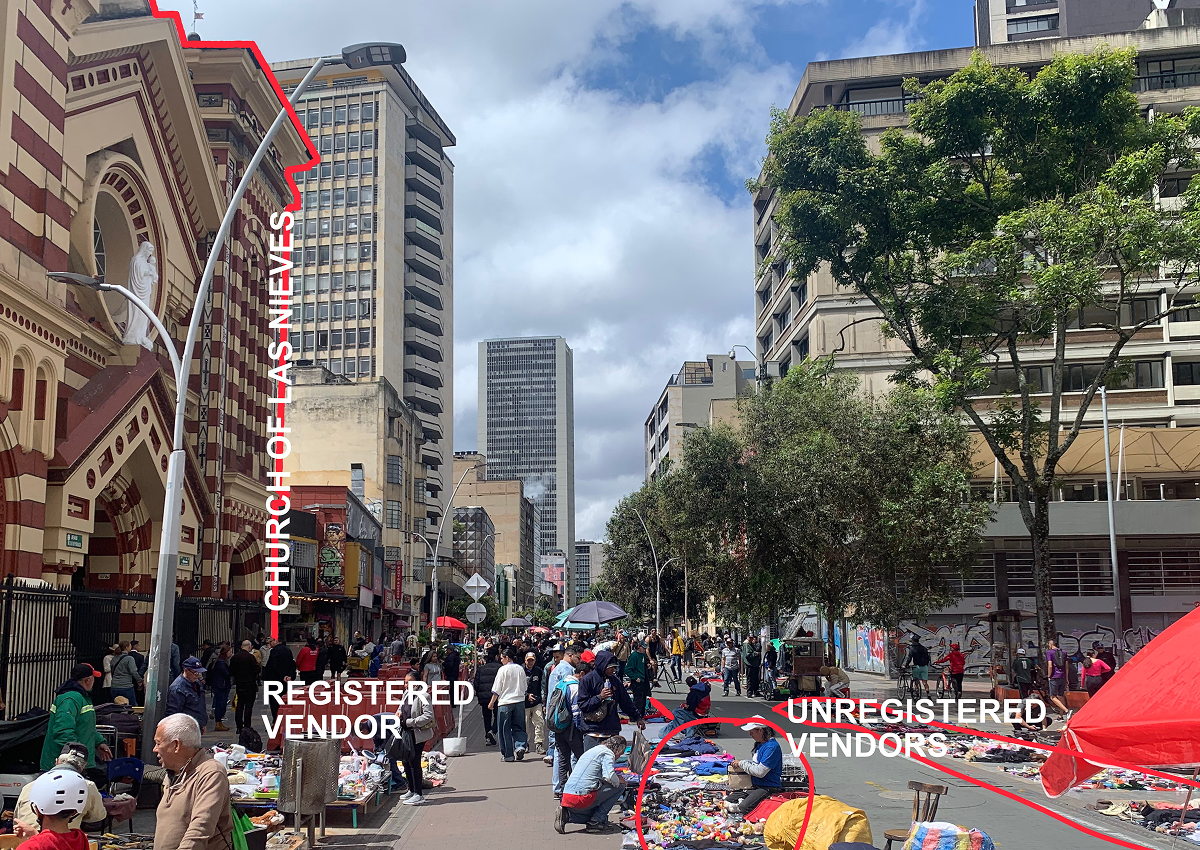
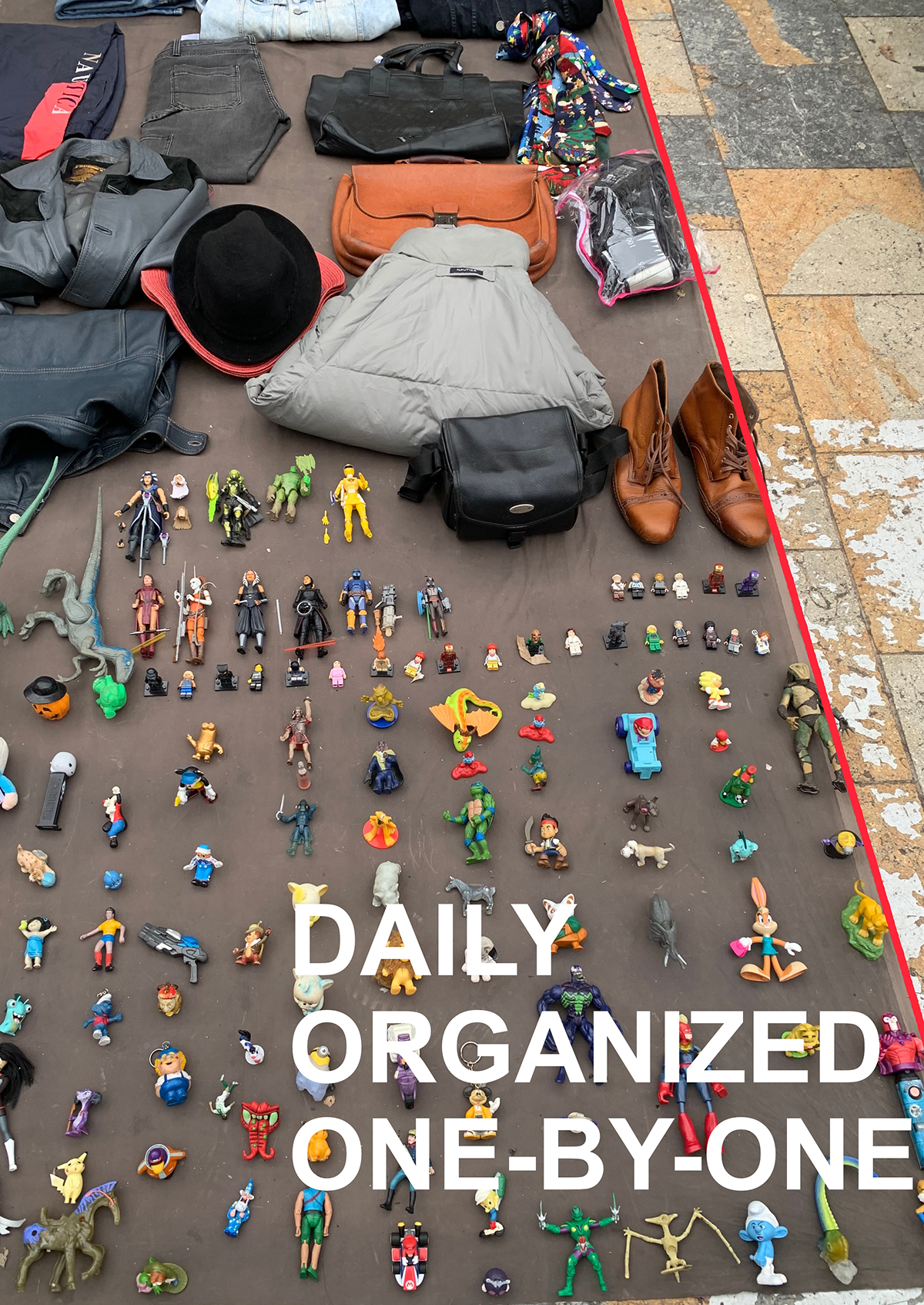
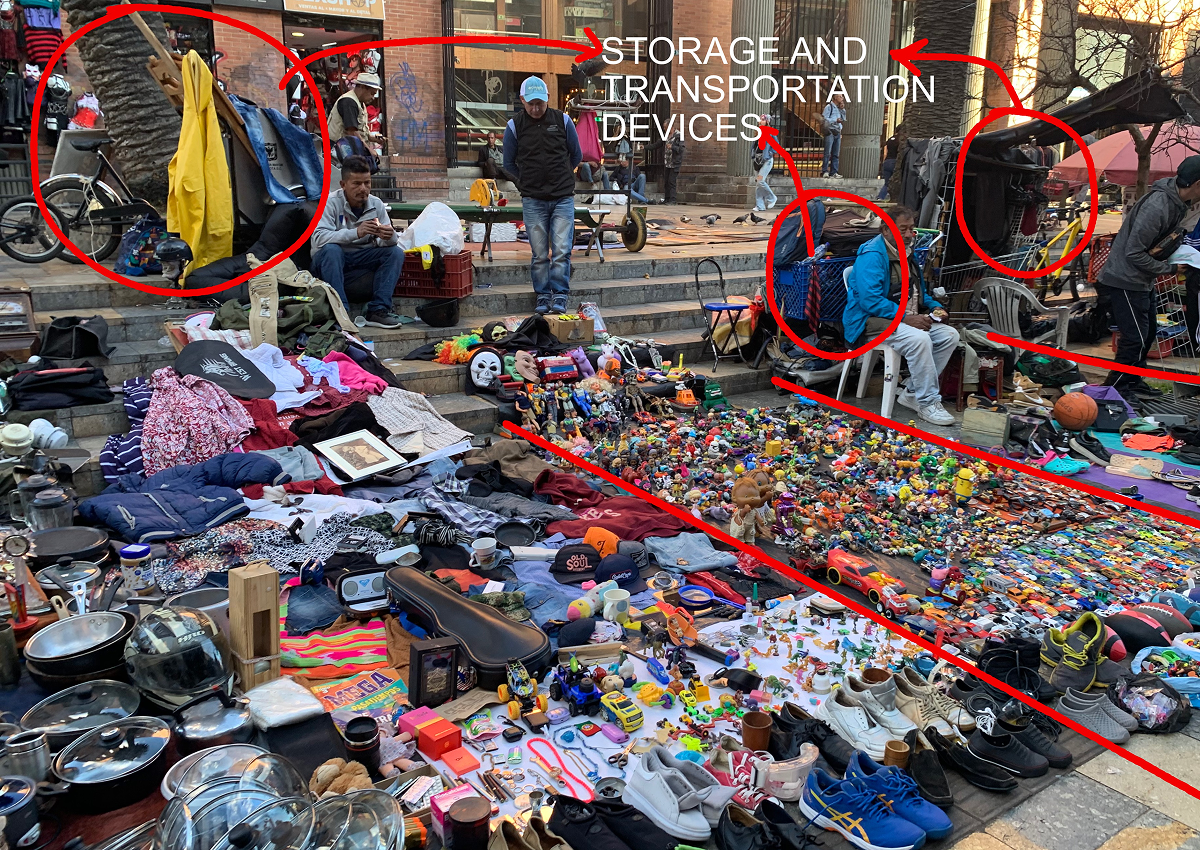
By midmorning, the corridor has transformed. That single cloth near Calle 24 is now one of dozens. Blankets and tarps extend in rough parallel lines along the edges of the pedestrian path and the painted bike lane. Shoes are arranged in pairs along the outer edge of each spread; toys cluster by size toward the center; books stack spine-up so titles can be read from a standing position. Second-hand clothes hang from improvised hooks or lie folded in columns sorted by color. Crates elevate some displays; others are ground-level compositions weighted by stones. Rolling carts occupy the mobile interior of the corridor. Together, these surfaces constitute what I call floating infrastructure: an assemblage that produces the conditions for exchange, display, legibility, comparison and transaction, without any fixed architecture around it.
La Séptima was pedestrianized in 2012, part of a long urban project that Donovan (2008) traces through decades of contested public-space politics in Bogotá. That same year, local authorities launched a registration program for informal vendors, issuing identification cards and linking each registered vendor to a rough portion of the corridor. The program formalizes a presence that has long existed, without fully fixing it. Most vendors remain unregistered. The market has never been recognized as an institution, and the vendors are classified as informales, a legal and administrative category that positions them outside the city’s official commercial infrastructure. Yet the market is entirely functional. Prices circulate, goods move, exchange repeats. What makes this possible is not a building or an institutional arrangement but a distributed set of materials, bodies, spatial knowledge and social relations that collectively do the work of infrastructure (Star 1999; Anand, Gupta and Appel 2018).
Infrastructure, in Star’s (1999) formulation, is most legible at breakdown: the pipe is noticed when it bursts, the road is felt when it ends. What the Séptima market adds is a form of infrastructure that does not break down so much as constantly reassemble. The term ‘floating’ names three conditions: the infrastructure’s spatial indeterminacy, occupying the corridor but anchored to nothing in it; its temporal impermanence, existing only through the daily repetition of material practice; and its legal suspension, persisting between the tolerance of registered vendors and the distance of municipal enforcement. It floats on spatial memory and on the social relations that hold the arrangement together in the absence of institutional support. This extends Simone’s (2004) insight that people can function as infrastructure where fixed systems are absent, but shifts the weight to things: the cloth, the crate, the plastic sheet which carry the market’s spatial logic from one day to the next. Vendors coordinate through objects as much as with each other; the cloth holds position, marks territory and produces the visual grammar by which a passerby reads a price and decides to stop. This is how market abstraction is materially sustained: no price list, no storefront, no fixed address, yet the market remains legible and comparable across its five blocks. Floating infrastructure is not simply mobile; it is differentially mobile, distributed across bodies and objects with unequal exposure to the forces that periodically require everything to move.
Prices on La Séptima are never fixed. They vary by vendor, by hour, by who is asking. A bookseller might call out a flat deal, “two thousand [Colombian pesos] for one, five thousand for three,” but most transactions begin with a question and proceed through negotiation. Vendors advise that evenings offer better deals: sales slow after five. On weekends, the market extends laterally into adjacent streets, new lines form along the cross-blocks, and competition increases. Prices do not necessarily rise with demand. Comparison is not abstract but produced through the arrangement of the spread, the practice of asking and the accumulated memory of yesterday’s prices (Callon 2021). The floating market self-regulates through density: more vendors = more comparison and harder bargaining.
This self-regulation is social and spatial, and it is where the differential mobility of floating infrastructure becomes most visible. The registration program produces a stratification that surfaces under pressure. Registered vendors carry identification cards that link them to a specific zone, while unregistered vendors—the majority—occupy whatever space is available. When an unregistered vendor sets up too close, the registered one may threaten to call the police. The threat works because raids are part of the market’s rhythm and unregistered vendors have no institutional claim. What Donovan (2008) traces across decades of public-space contestation in Bogotá, the recurring question of who has the right to occupy the street and on whose terms, finds a contemporary form here. The registration program does not resolve that question; it rescales it, producing what Gago (2017) calls popular pragmatics as actors absorb and navigate the regulatory frameworks that nominally govern them, on terms they did not set.
Raids arrive with anticipation. Police patrols come from the direction of the local administration buildings; someone sees them, spreads the word and within minutes goods are gathered, cloths folded and vendors dispersed. Rain announces itself through drizzle. One vendor explains the protocol: the first drops allow a few minutes to decide whether to wrap in place, move toward the building facades, or pack up entirely and leave. Speed and care are in tension: goods need to be covered quickly, but wrapping done badly can damage them. In light rain, vendors layer black plastic sheeting over their displays and press close to the shuttered storefronts. In heavy downpours and during Bogotá’s rainy season, between May and November, everything disappears. Not a single vendor remains on the pedestrian surface.
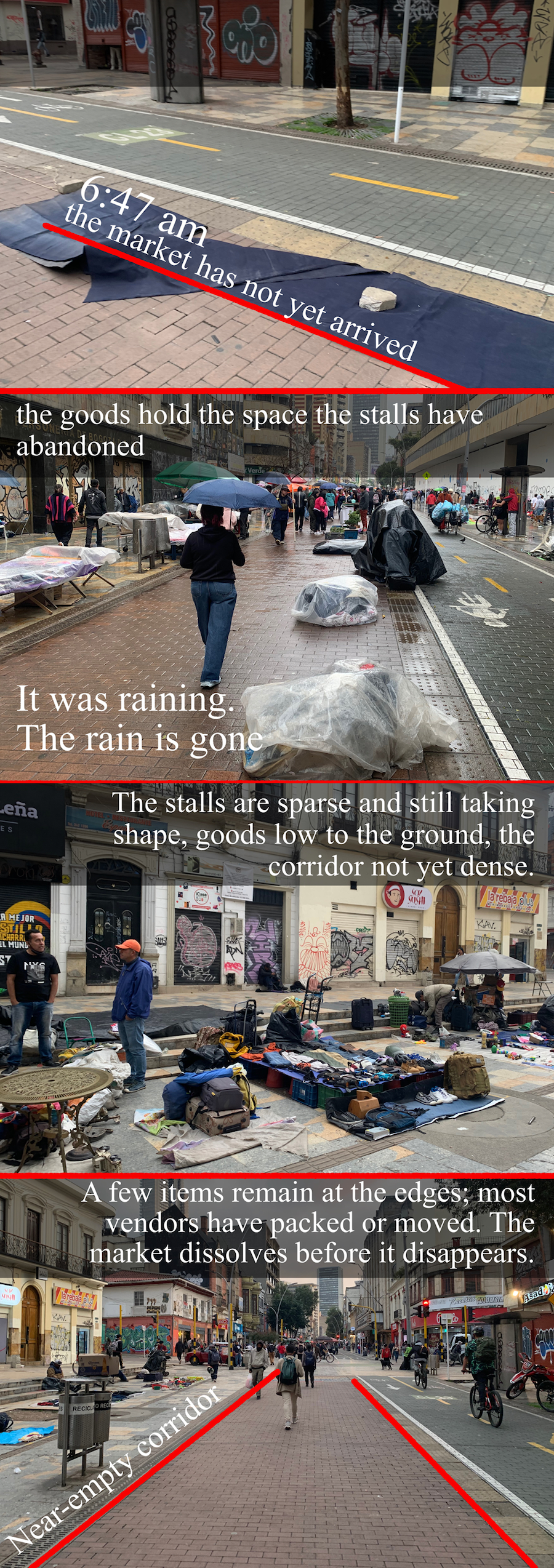
This market holds together through materials and bodies that carry spatial knowledge: when to come, where to set up, which direction raids arrive from and how many minutes a drizzle allows. Here, breakdown is routine, and reconstitution is the ordinary condition. Rain, police patrols, the approach of night—each disperses the market and calls it back. What Simone (2004) describes as “people as infrastructure” runs through every sequence: the warning passed around when officials appear, the calibration of who can occupy which spot, the collective knowledge of the rainy season’s rhythms.
Recovery after disruption follows no written protocol but is improvised from shared knowledge and repeated practice, which Jackson (2014) identifies as repair: the ongoing work of keeping functional what no single authority has built. Each morning’s ritual, the cloth unrolled, the figures placed where they belong, is in this sense a repair. Not restoration to an original state but reconstitution of a condition that exists only insofar as it is actively reproduced. The infrastructure floats not because it is fragile but because its stability is of a different kind: distributed, embodied, material and daily.
By seven in the evening, the packing up has begun. It does not resemble the morning. Goods are gathered quickly and thrown into bags. The same suitcases opened with deliberation at dawn are now filled without order. The cloth comes up last, folded loosely, tucked under an arm. By eight-thirty, the corridor is nearly empty. The final vendors disappear into the dark of downtown Bogotá, carrying everything they came with. Tomorrow, the cloth goes down again on the same patch of pavement. The figures are placed where they belong. The market floats back into form.
Identify a space in your city where informal or semi-formal exchange takes place, a street-food area, a weekend market or a sidewalk vendor cluster. Then visit it twice: once during peak hours and once at setup or closing time.
During each visit, take three photographs and write 150 words of field notes answering these questions:
Select one photograph and annotate it, drawing lines and labels that identify the display surface, storage devices, territorial boundary and escape routes.
Write one page connecting this annotated photograph to one concept from the article. You do not need to use all the concepts, depth on one is the goal.
Class discussion centers on three questions:
Anand, Nikhil, Akhil Gupta and Hannah Appel (eds.). 2018. The Promise of Infrastructure. Duke University Press.
Callon, Michel. 2021. Markets in the Making: Rethinking Competition, Goods, and Innovation. Edited by Martha Poon. Translated by Olivia Custer. Zone Books.
Donovan, Michael G. 2008. “Informal Cities and the Contestation of Public Space: The Case of Bogotá’s Street Vendors, 1988–2003.” Urban Studies 45 (1): 29–51.
Gago, Verónica. 2017. Neoliberalism from Below: Popular Pragmatics and Baroque Economies. Translated by Liz Mason-Deese. Duke University Press.
Jackson, Steven J. 2014. “Rethinking Repair.” In Media Technologies: Essays on Communication, Materiality, and Society, edited by Tarleton Gillespie, Pablo J. Boczkowski and Kirsten A. Foot, 221–39. MIT Press.
Simone, AbdouMaliq. 2004. “People as Infrastructure: Intersecting Fragments in Johannesburg.” Public Culture 16 (3): 407–29.
Star, Susan Leigh. 1999. “The Ethnography of Infrastructure.” American Behavioral Scientist 43 (3): 377–91.