This is some text inside of a div block.
Search across the whole Roadsides site


With a natural harbour and abundant fish stocks, Vizhinjam is home to a large population of small-scale fish workers. Fishing here is carried out largely by the Mukkuvar, a Latin Catholic fishing community. The harbour itself is tucked into a densely populated neighbourhood within the coastal stretch of Thiruvananthapuram district of Kerala, India. The introduction of the Vizhinjam International Seaport, a multipurpose transshipment port, adjacent to the harbour, has created a site of constant conflict, dispossession, desires and opportunities. This port frontier results from its entanglement with the physical infrastructures surrounding the harbour and its functioning, which includes the multitudes of Mukkuvar livelihoods associated with small-scale fish production. The harbour functions as a central marketplace, where the core activities of fishing, selling, buying and auctioning the catch, are concentrated.
The harbour also encompasses diverse forms of livelihoods, each of which reflects the inherent inequality within the Mukkuvar. While being homogenous in terms of religion and caste, the Mukkuvar community has also witnessed internal fragmentation that emerged as a result of structural shifts in livelihood patterns. A significant number have moved away from small‑scale fishing, diversifying into government service, migrating to other states and countries, or seeking alternative forms of urban employment. These transitions have contributed to pronounced inequalities within the community, where those engaged in fishing remain socioeconomically marginalized compared to other groups and individuals (Krishnan and Mallick 2026). The inequalities and the spatialized hierarchies surrounding the harbour, shaped over the decades by migration, mobility, capital accumulation and an inherent feudal structure facilitated by the Church (Subramaniam 2009; Ashni and Raghavan 2019) ultimately shape the many spatial imaginaries at play here—the ways in which the Mukkuvar perceive, conceptualize and assign meaning to the coastal space (Subramaniam 2009).
This essay conceptualizes the spaces surrounding the harbour, which prior to the existence of the port were focused on catering to the harbour and its economy, as a palimpsest of imaginaries subsequently producing a port-city—a place where earlier histories and infrastructure are altered, co-existing with new ones layered upon them (DiCarlo 2020). These are contested spaces where diverse histories, forms of labour, everyday economic vulnerabilities and ambivalent aspirations for modernity overlap. New initiatives and infrastructures continually emerge here, not replacing, but overlapping with the harbour and its activities, all part of efforts to increase maritime trade and economic growth. However, these developments occur at the risk of losing access and mobility for the Mukkuvar fish workers, who remain among the lower echelons of the community. The observations that form the basis of this study were made during my fieldwork in Vizhinjam and adjacent coastal villages between August 2022 to July 2023.
One could say that the fishing community is built around its harbour, embracing the small houses and shops, narrow paths, parish church, shops for fishing equipment and groceries, ice factories, mechanics’ workshops, platforms for fish vending, boats, net making and leisure activities. These infrastructures all contribute to the complex economy of the harbour, one that is riddled with inequalities, distinct identities, histories, memories, desires and the mundanity inherent in the catching, processing and vending of fish. As I waited at the harbour, bustling with people buying and selling, diverse forms of labour relations unravelled amidst the commotion that continued through the night. The men ventured out in the evening, returning with their catch one after the other. They must travel far from shore, until the sight of land disappears. Previously they would fish much closer in, but the port demarcations have forced them to push farther. Although these boats have adapted to the change, shore seine-net workers remain affected as these shore-based fishers have lost access to the fishing grounds due to the demarcations. As they reach the harbour, auctioneers, women vendors and other local buyers huddle around the motorized boats, which are loaded with a variety of fish types.
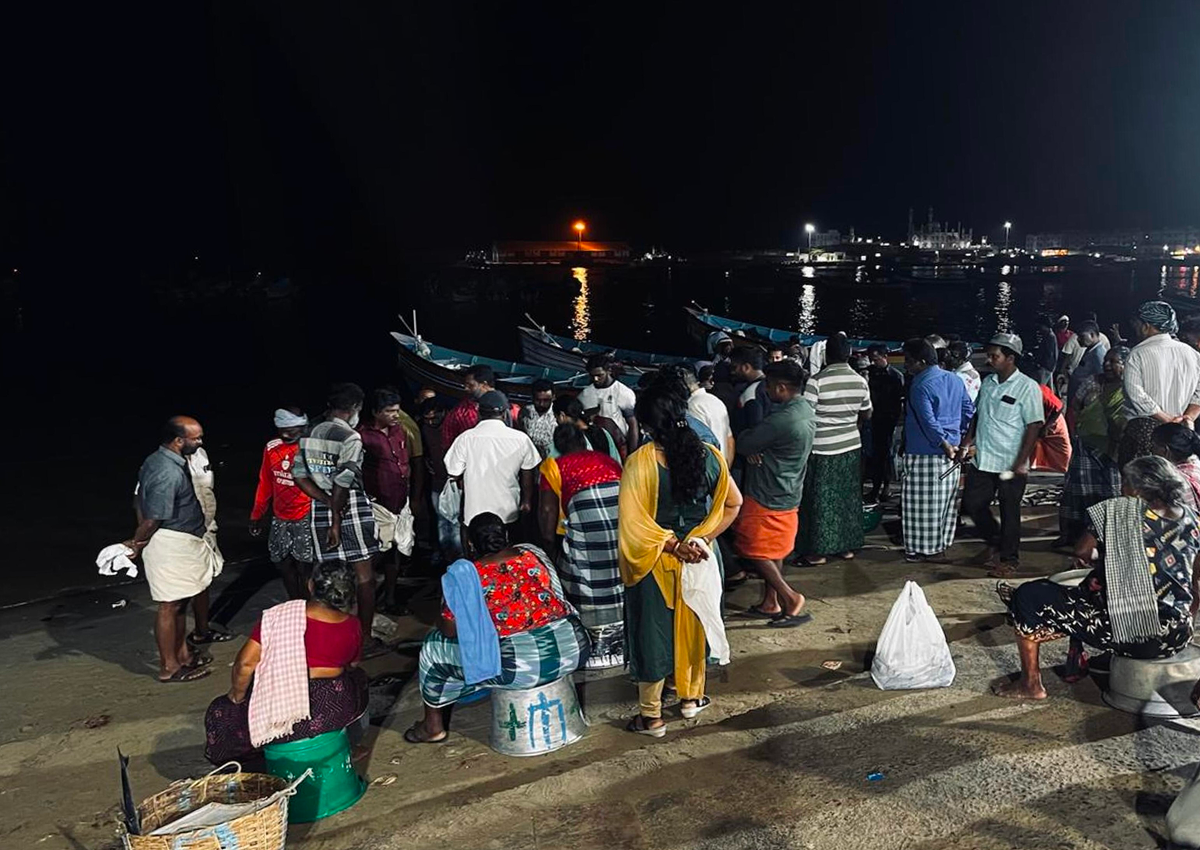
The workers and boat owners get their share after paying the Kuthaga (tithe)—a tax imposed by the Latin Catholic Church, where they are required to pay one-tenth of their catch, or sales proceeds in today’s scenario. This practice has its roots in the colonial period (Mathew 2020). The tithe is paid to the Vizhinjam Parish Church, where it is then used for sustaining the harbour. This gives the Church a certain control over the marketplace and its economic activities. The nets, engines and equipment are parked on a common platform, guarded by the men in rotation all day. The women buy fresh and sellable of the lot, while the auctioneers bid for the best price. They pick up large basins of fresh fish, heading to autorickshaws that wait for them at the exit ready to transport stock to the markets. Some days the sales are handsome, while other days they are slow. At the break of dawn the crowd dissipates, with workers parking their boats and meticulously packing away their nets. The harbour, while owned by the Kerala government, is maintained and managed by the Church, and rules for fishing are set out by the latter. These regulations are followed by all fish workers so as to not deplete the fish stocks. Moreover, the Church uses the Kuthaga tithe for the infrastructural maintenance and welfare of the Mukkuvar engaged in the fishing sector. This creates an informal infrastructure (Simone 2004), community focused and church driven, which comprises net-makers, boat mechanics, dried-fish makers and numerous others. These groups within the Mukkuvar are entirely dependent on fishing, and the associated coastal and marine resources.
Construction of the international seaport has not really affected the women of Vizhinjam as they still always have fish to sell, except during the lean season. Prior to the construction of the seaport, which began in December 2015, the boat owners, workers and women vendors largely depended on local buyers, small-scale merchants and the public. The influx of port labourers and the emergence of supporting establishments, as construction of the seaport progressed, expanded their customer base. Just a few years back, before the arrival of the seaport, Vizhinjam north was a coastal rural area, with only few food joints, inhabited by fishing communities. With the seaport and its surroundings being fully operational from 2024, the region has seen significant development, becoming one of the major culinary sites of Thiruvananthapuram district, particularly for seafood. These establishments are owned by wealthy Mukkuvar and non-Mukkuvar. With the introduction of Vizhinjam International Seaport, new futures, infrastructures and labourers entered the coastal landscape, further strengthening the existing spatialized hierarchies surrounding the harbour.
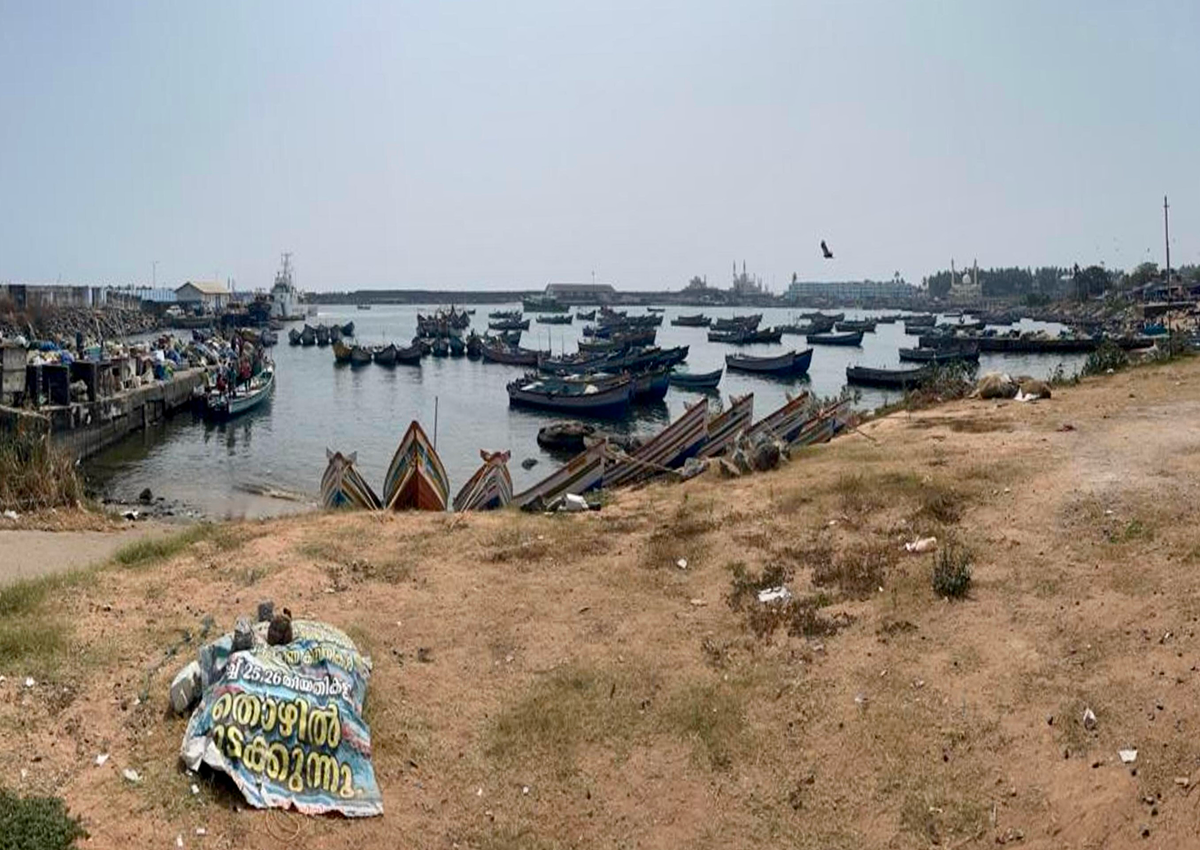
While construction actually began in 2015, the seaport has existed in the minds of the people since 1991, when the idea for it was first conceived. It was welcome in the imaginations of a fishing community whose lives were mired in economic uncertainty and social insecurity. Small‑scale fishing had become less sustainable and aspirations for social security, economic certainty and dignity fuelled the desire for alternative forms of livelihood (Krishnan and Mallick 2026). Apart from these factors, the infrastructural decay that their everyday lives and livelihoods centred around fostered excitement for development in the form of the port infrastructure. Before the port came a procession of promises of opportunities and better infrastructure as a solution to their poor living and working conditions. These included improved homes, overhauled water systems, enhanced connectivity and an upgraded harbour. As for the few Mukkuvar who had left the fishing behind and lived a life of accrued wealth, the port offered the opportunity for capital investment and high real estate value. So, while the particular desires differed among the various Mukkuvar stakeholders, they never ceased to exist.
With the seaport being constructed, the Mukkuvar neighbourhood surrounding the harbour underwent significant change, with well-lit streets, water connectivity and concrete roads. Some of the children of these families were employed in the seaport, and some went to work in the new establishments that emerged alongside it, such as logistics companies, restaurants, accommodation, truck services and so on. New, designated fish markets opened up for the women vendors. But despite all this, cracks still worked their way through the livelihoods and homes of the Mukkuvar fish workers. Dredging and piling for construction of the breakwater affected mussel collectors. The cost of fuel and travel distances increased, with boat-owners incurring significant losses. Spaces once shared for leisure, games and religious gatherings were taken over by the port. Thus, the neighbourhood received better infrastructure in exchange for constrained mobility and reduced commons.
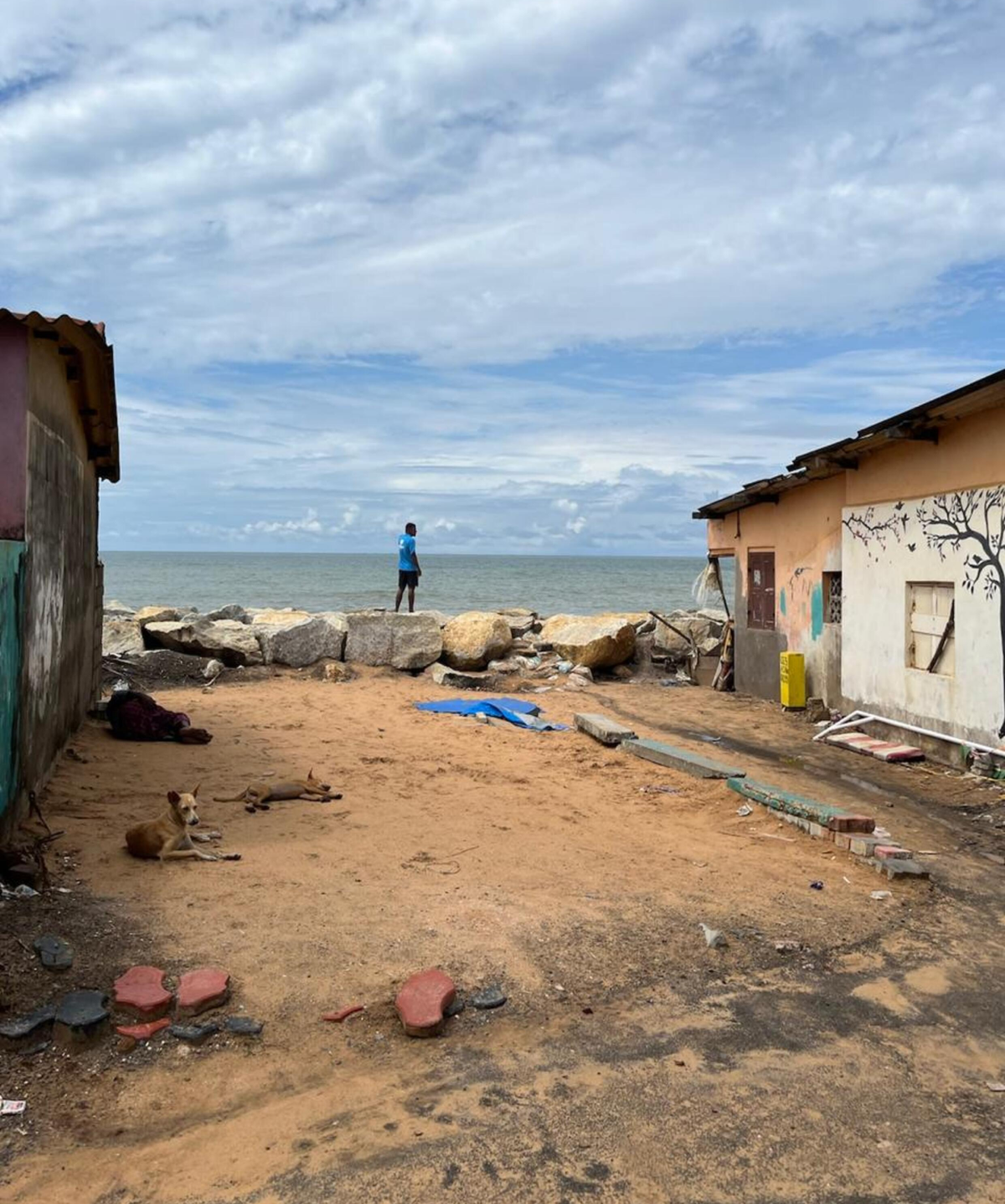
The seaport’s construction did not essentially replace or dissolve the original harbour; rather, it brought in new forms of labour relations, opportunities and territorial divisions. Novel desires, histories, identities and imaginaries are layered over those that were shaped through generations, centring on the harbour and the Mukkuvar population. Operating as an infrastructural palimpsest (Moss 2020), these conflicting and overlapping desires transform the coast around Vizhinjam into a port-city, with new corporate stakeholders venturing into a peri-urban landscape that once entirely relied upon the harbour and the small-scale fishing that sustained it.
Ashni, A. L. and Santhosh Raghavan. 2019. “Catholic Church, Fishers and Negotiating Development: A Study on the Vizhinjam Port Project.” Review of Development and Change 24 (2): 187–204.
DiCarlo, Jessica. 2020. “Development as Palimpsest: Infrastructures Revived in Boten’s Architecture.” Roadsides 4: 15–23. https://doi.org/10.26034/roadsides-202000403
Krishnan, Shilpa and Sambit Mallick. 2026. “Coastal Erosion, Enclosure and Displacement: The Impact of the Vizhinjam International Seaport in Kerala.” Development and Change 57: 50–78.
Mathew, T. P. 2020. Between the Sea and the Sky: Lived Religion on the Seashore. Fortress Press.
Moss, Timothy. 2020. Remaking Berlin: A History of the City through Infrastructure, 1920–2020. MIT Press.
Simone, AbdouMaliq. 2004. “People as Infrastructure: Intersecting Fragments in Johannesburg.” Public Culture 16 (3): 407–29.
Subramanian, Ajanta. 2009. Shorelines: Space and Rights in South India. Stanford University Press.